How to Quit Sugar: A 30-Day Plan That Leaves Room for Slips
The short answer
Start by defining what you’re quitting: added sugars and sweet drinks. Whole fruit stays. Write a rule you can check every evening, clear the temptations out of your home, and hold on for 30 days, logging your slips without starting from zero in your head. If you have diabetes or a difficult relationship with food, see a health professional first.
What “quitting sugar” really means
Nobody quits sugar in the strict sense: there’s some in an apple, a glass of milk, a carrot. What most people are after is cutting back on added sugars and the products loaded with them: soda, cookies, pastries, breakfast cereal, store-bought sauces.
The World Health Organization uses the term free sugars. It covers sugars added to foods and drinks by the manufacturer, the cook or the consumer, as well as the sugars naturally present in honey, syrups, fruit juices and juice concentrates. The WHO recommends that adults and children keep free sugars below 10 percent of their total energy intake. The recommendation does not cover the sugars in fresh fruit and vegetables or in milk.
So you don’t have to give up fruit. Fruit juice, on the other hand, counts as free sugar even with nothing added, and the WHO fact sheet on healthy eating advises limiting it.
If you have diabetes, take medication that affects your blood sugar, are pregnant, or have a history of eating disorders, talk to your doctor or a dietitian about this plan before you change what you eat. Do the same if your sugar cravings feel out of control or cause you distress. What follows is about building a habit and is not medical advice.
Write a rule you can check
“Eat less sugar” can’t be checked. In the evening you won’t be able to say whether the day held, and when in doubt you’ll give yourself the benefit of it. You need a rule that comes down to a yes or a no. A few examples, from the most flexible to the strictest:
- no sweet drinks, soda and juice included;
- no sweet desserts or sugary snacks on weekdays;
- nothing that lists sugar among its first ingredients;
- no added sugar at all, with one chosen dessert on Saturday.
Pick just one and write it down word for word. Plan your exceptions now, with a cool head: a birthday, dinner at a friend’s place. An exception you decided on ahead of time is part of your rule. One you invent in front of the bakery window counts as a slip.
If you don’t know where to start, drinks are the easiest way in. You can swap them for water, tea or unsweetened coffee, and the rule leaves no gray area. The article on a water reminder can help you set up the swap.
Prepare the ground
An open bag of cookies in the cupboard ends up eaten, whatever you decided that morning. What isn’t in your home, on the other hand, you have to go out of your way to get. Before day one, do three things.
Read the labels of what you usually eat. Sugar often turns up in products that don’t taste sweet: sandwich bread, sauces, flavored yogurt. You don’t have to ban everything, but you’ll know what your rule covers.
Put away, give away or finish the sweets lying around, then don’t buy them again.
Plan what you’ll eat instead at the risky moments. The 4 p.m. snack and the end of dinner are the two most common. A piece of fruit, a handful of unsweetened dried fruit or nuts, a plain yogurt: choose one specific answer so you don’t have to improvise when the craving hits.
Hold on for 30 days with a program
Thirty days give you a short horizon, with a start and an end, which makes it easier to begin. By the end, you know what comes easily to you and what doesn’t.
HabitLove has a “Sugar free” challenge in the Challenges tab, under the heading “30-day challenges.” When you start it, you get a habit to quit and a program split into four weeks: “The basics,” “Cravings,” “Everyday life,” “Lasting change.” Each day shows a “Today’s tip.” The first week’s tips cover the preparation described above: “Pick your reason,” “Spot the hidden sugar,” “Clear the temptation zone,” and “Drink a big glass of water” when a craving arrives.
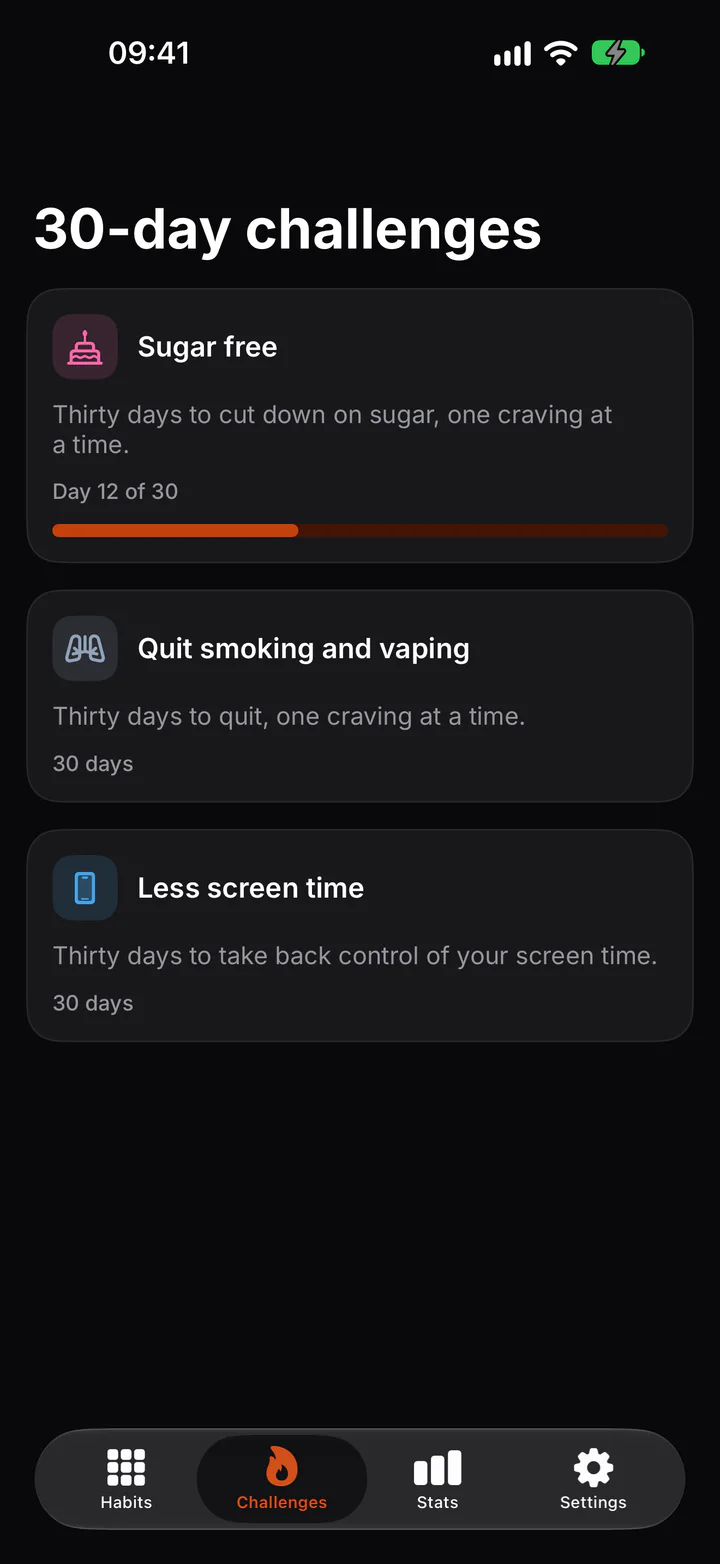
You can also skip the challenge and create your own habit of the “Quit” type, named after your rule. It works the same way. A habit to quit is tracked every day, and each day counts as clean by default. You don’t check off the days that go well; you only report the days you gave in.
The day you give in
It will happen, at a coworker’s going-away party or a Sunday lunch with your parents. The usual reasoning goes like this: I had a slice of cake, the day is ruined, I might as well finish the cookies, and I’ll start again Monday. With that reasoning, one slice of cake turns into five days off the plan.
Logging the slip right away breaks that slide. In the habit’s detail, the “I slipped” button asks you to confirm and spells out what happens: your streak restarts from zero, your grid stays, tomorrow is a new tile. The day gets a slip mark, and the clean days around it don’t change.
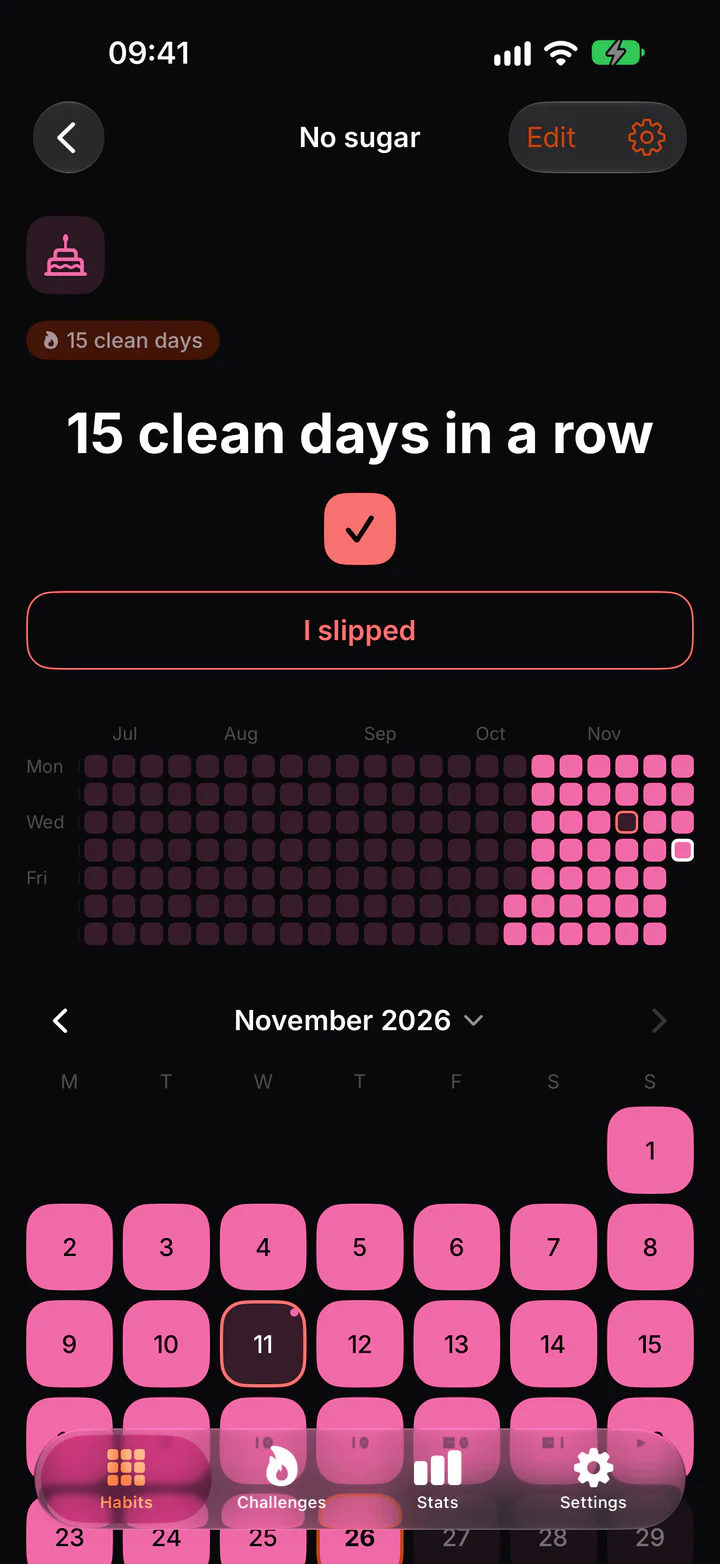
The “No sugar” habit in the screenshot shows what this looks like: about forty days, a single slip, and the small dot that tells you it has a note. Write a few words on the context of each slip: tired, drinks after work, bored in front of the TV. After three or four notes, the same situations come back, and you know where to put your effort. The article on streaks and slips goes further into reading a grid after a relapse.
If you logged a slip by mistake, you can undo it, and the day becomes a clean day again.
After the 30 days
At the end of the month, go back over your grid and your notes before you decide anything. You then have three reasonable options.
Keep the rule as it is, because it no longer costs you much. The habit goes on, without the program, and the grid keeps growing.
Loosen it. A strict rule kept for thirty days can become a weekday rule, with weekends free. Say so clearly and rename the habit, so the grid keeps measuring something precise.
Switch to a limit. If quitting completely doesn’t suit you, you can track a number: a habit to quit with a “Counter,” with a daily limit, counts your treats and keeps the day a success as long as you stay under the limit. That’s the approach described in the article on coffee, and it works just as well for one square of chocolate a day.
If the challenge went badly, you can start it again later. Giving up a running challenge keeps your grid and your history, so nothing you held on to is lost. And if, after several tries, you can’t cut back even though you really want to, or if food takes up too much room in your thoughts, make an appointment with your doctor. Some difficulties with eating call for support that no tracking app provides.
Frequently asked questions
Do I have to give up fruit too?
No. The WHO recommendation is about free sugars: the ones added to foods and drinks, plus the sugars in honey, syrups and fruit juices. It does not cover the sugars naturally present in fresh fruit and vegetables or in milk.
How long do sugar cravings last?
It varies from person to person, and there is no reliable figure that applies to everyone. What you can observe yourself: log your slips and their context for 30 days, and you’ll see whether the cravings come less often and at what moments they come back.
What if I slip during the 30 days?
Log the slip and keep going the next day. In HabitLove, the “I slipped” button marks the day: your streak restarts from zero, but your grid keeps every clean day. One slip in thirty days still leaves twenty-nine days on which you changed your habits.
Should I talk to someone before cutting down on sugar?
Yes if you have diabetes, take medication that affects your blood sugar, are pregnant, or have or have had an eating disorder. Your doctor or a dietitian can adapt the approach to you. This article is about habits and does not replace medical advice.
Sources

Track this habit in HabitLove
One grid per habit, with reminders and streaks. Free, no account needed.