How to Build a Habit That Sticks

The short answer
A habit sticks best when it is small, precise and tied to a fixed moment in your day. Choose one action, decide what it comes after, and log every day whether you did it. Plan on several months: in a study published in 2009, the estimated time for a behavior to become automatic ranged from 18 to 254 days, depending on the person.
Why so many habits fade after two weeks
In January, you decide to run three times a week, read more and get to bed earlier. By the end of the month, what’s left is often a pair of running shoes by the front door. The plan asked for too many decisions every day: when to run and for how long, what to read, what time to turn off the light. Each decision costs a little energy, and on tired evenings there’s none left.
A habit that sticks is something you do without having to talk yourself into it. To get there, the action has to be small enough to survive a bad day, and it needs a fixed place in your day. You also log it every day, so you can see whether you’re keeping it up.
Pick one small, precise action
“Exercise more” is an intention. “Do ten push-ups” is an action: you know when it starts and when it’s over, and you can answer yes or no to the question “Did I do it today?”
Two tests help you find the right size. First, could you do it on a night when you get home late and in a bad mood? If not, shrink it. Reading twenty pages becomes reading two, and meditating for twenty minutes becomes sitting still for three. Second, could someone watching you tell whether it’s done? “Eat better” fails that test, while “a piece of fruit with breakfast” passes.
For the first few days, an action this small feels a little silly. You do it anyway, late and grumpy evenings included, and those evenings are what build the habit. On days when you have energy you can do more, but the minimum stays the same. The article on daily push-ups applies this idea to an exercise you count.
Tie it to a moment that already exists
A habit is easier to start when it follows something you already do every day. Instead of “I’ll meditate in the morning,” write “after I start the coffee, I sit down for three minutes.” The coffee becomes the signal, and you no longer have to choose the moment.
Good anchors happen every day, at roughly the same time and in the same place: waking up, the shower, lunch, walking in the door after work, brushing your teeth. Poor anchors are vague (“when I have a minute”) or irregular (“after the morning meeting,” which doesn’t happen on Fridays).
The night before, put the book on your pillow or roll out the mat. A full water bottle already on your desk works the same way: every obstacle you remove in advance is one decision you won’t have to make on the day. If you want ideas for the start of the day, the article on morning habits suggests several.
Log it every day, in one tap
Tracking lets you see at a glance whether you’re consistent, without relying on memory, which tends to flatter you. Checking something off also gives you a small reward right away, while the effects of the habit take weeks to show.
For tracking to last, it has to take a few seconds. In HabitLove, you create the habit from the Habits tab: a name, an optional description (the app asks “Why this habit?”), the type, Build or Quit, then the tracking. Yes / No works for most habits. Counter fits when you’re aiming for a quantity, like eight glasses of water, and Measure when you log a value with a unit, such as miles.
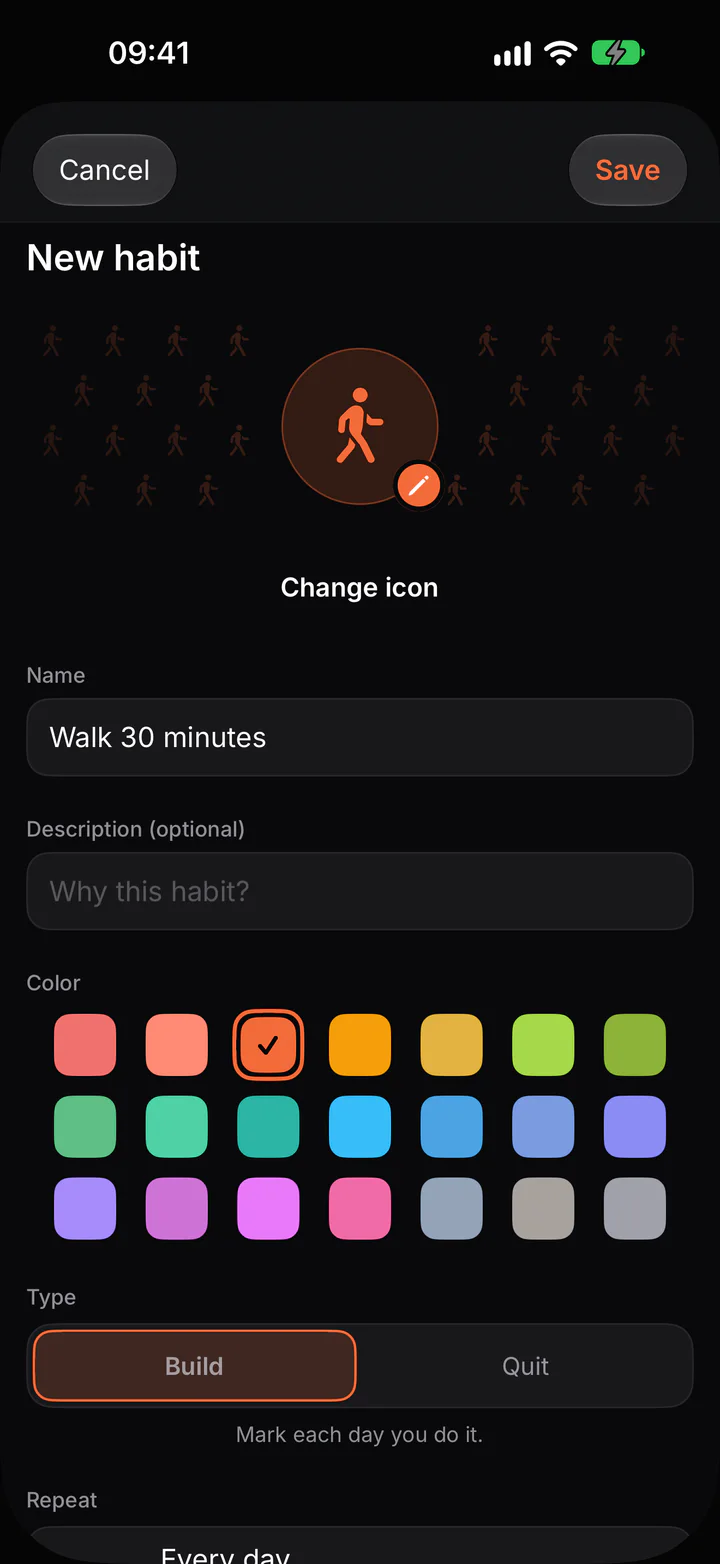
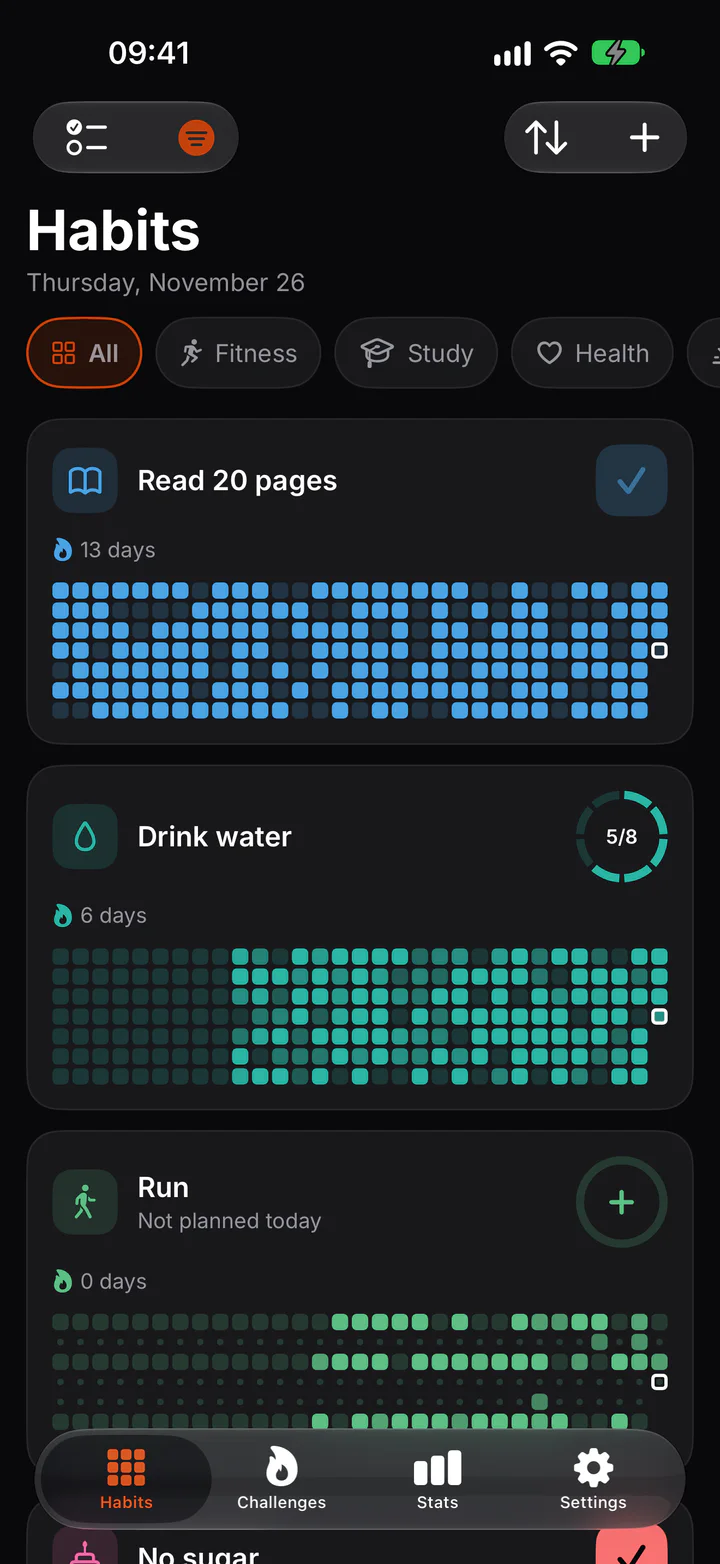
After that, one tap on the check button of its card logs the day and adds a tile to its grid. If you forgot to check it yesterday, “Complete yesterday” fixes that from the Habits tab. To see what a grid shows that a plain list of boxes doesn’t, read about the grid method.
A reminder helps in the first weeks, while the anchor isn’t automatic yet. Set it to the time of your anchor rather than to a round hour: if you meditate after your 7:30 coffee, a reminder at 7:35 lands at the right moment, while one at 9:00 reaches you when you’re already at work.
Expect it to take months
You’ve probably read that it takes 21 days to form a habit. A study published in 2009 gives very different numbers. Phillippa Lally and her colleagues followed 96 volunteers for twelve weeks. Each person chose one eating, drinking or activity behavior to repeat daily in the same context, after breakfast for example. By their calculations, the time it took for the behavior to become automatic ranged from 18 to 254 days, depending on the person.
With a range that wide, comparing yourself to someone else tells you nothing about your own pace. A simple action is also easier to repeat every day than a demanding one, which is one more reason to start small.
The same study found that missing one opportunity did not materially affect the habit-forming process, and the days you already logged still count. The article on streaks and slips explains how to pick up again without giving up on the whole thing.
Three common mistakes
The first is starting five habits on the same Monday. They compete for your attention and fall apart together at the first surprise. Start with one, and add the next when the first takes almost no effort.
Another is aiming for a daily rhythm with an activity that doesn’t suit one. When you’re new to it, running every day is hard to sustain. Three times a week is an honest goal, and the app can track that without breaking your streak on rest days.
Many people also raise the bar too soon. After ten good days, you want to double the dose, and the new version no longer survives the bad evenings. Keep the same minimum to check off for several weeks, even if you do more on some days.
A complete example
Take reading. The starting intention is “read more.” The action becomes “read two pages,” the anchor “once I’m in bed, before turning off the light,” and the preparation is leaving the book on your pillow when you make the bed in the morning. In the app, you create a Yes / No habit with a reminder around your bedtime.
On the first few nights, two pages often turn into ten, because opening the book was what took the effort. Some nights you stop at two, and the day gets checked off all the same. After a few weeks, the grid shows an almost full row, and you can move on to a bigger goal, as described in reading 20 pages a day.
If you want to try it with a habit of your own, HabitLove is free and doesn’t ask you to create an account.
Frequently asked questions
How long does it take to build a habit?
There is no fixed length. In the study by Lally and colleagues, published in 2009, the estimated time for a behavior to become automatic ranged from 18 to 254 days. It depends on the person and on how hard the behavior is.
Should I start several habits at once?
It’s better to start one and wait until it happens almost without thinking before adding the next. New habits compete for the same attention, and one bad day can knock them all over together.
What if I miss a day?
Pick it up again the next day without trying to make up for it. In the same study, missing one opportunity did not materially affect habit formation. If missed days start to pile up, make the action smaller or move it to another moment.
What is the best time of day?
A moment when you already do something every day without effort: your morning coffee, getting home from work, brushing your teeth. The exact hour matters less than how regular that anchor is.
Sources

Track this habit in HabitLove
One grid per habit, with reminders and streaks. Free, no account needed.