How to Read 20 Pages a Day and Keep It Up

The short answer
Twenty pages often take about half an hour, and at that pace you finish a 300-page novel in fifteen days. To keep it up, give reading a fixed slot, keep the book where you read, and allow yourself a short version on tired evenings. Check off each day you read and note where you are: the grid shows the rest.
What twenty pages add up to
Twenty pages is little enough to fit into a normal day and enough to make real progress. At that pace, a 300-page novel takes fifteen days, or about two books a month. Even if you skip one day in three, you still finish a book a month.
The number has two strengths: it’s easy to verify, and it gives each session an end. “Read more” doesn’t tell you when you’re done. “Twenty pages” does, and you can close the book without wondering whether you did enough.
Before you commit, measure your speed on the book you’re reading now. Set a ten-minute timer, count the pages, multiply. If twenty pages take you forty-five minutes because you’re reading dense nonfiction, aim for ten pages instead, or count in minutes, so the goal stays within your slot: if it spills over, it won’t last long.
Format matters too. Twenty pages of an airy paperback and twenty pages of a big hardcover in small print aren’t the same length. If you switch between them often, or read on an e-reader, where the page number depends on the font size, count in minutes: twenty-five or thirty minutes of reading gives you a benchmark that doesn’t depend on the book.
Find the slot
Half an hour doesn’t free itself up. You have to take it from somewhere, and you’ll usually find it in one of three places:
- the evening, in place of the last half hour of scrolling or TV
- your commute, if you get a seat on the train or bus
- your lunch break, once you’ve finished eating
The evening is the most common slot and also the most fragile, because it comes when you’re tired. To help it along, put the book on your pillow when you make the bed in the morning, and leave your phone to charge somewhere else. That second step matters more than the first. The article on screens in the evening explains how to organize that last hour.
You can also split the goal in two, ten pages on the train and ten in bed. Two short slots hold up better against surprises than one long one, and the book stays part of your day.
Choose books you want to open
A reading habit depends on the book first. If you’ve been dragging through a doorstop for three weeks because you think you should finish it, you won’t open it tonight, and no method will change that. Drop it without guilt, or set it aside for later. Libraries are full of books someone else loved.
Always have the next book ready, so you’re never left one evening with nothing to read, and mix up genres: after demanding nonfiction, pick a novel that reads itself. Some readers keep two books going, one for the evening and one for the commute. That works if the two are very different.
Also keep a list of what you want to read next, on paper or in your notes app. When a friend recommends a title or a bookstore puts one in front of you, add it. The day you finish a book, the next one is already picked, and you don’t lose a week looking.
Track it without turning reading into homework
For reading, the simplest tracking is enough: a “Yes / No” habit, checked when the twenty pages are read. In HabitLove, the habit in this article’s screenshots is called “Read 20 pages.” Its detail screen shows its grid, one tile per day, along with the current streak and the calendar for the month.
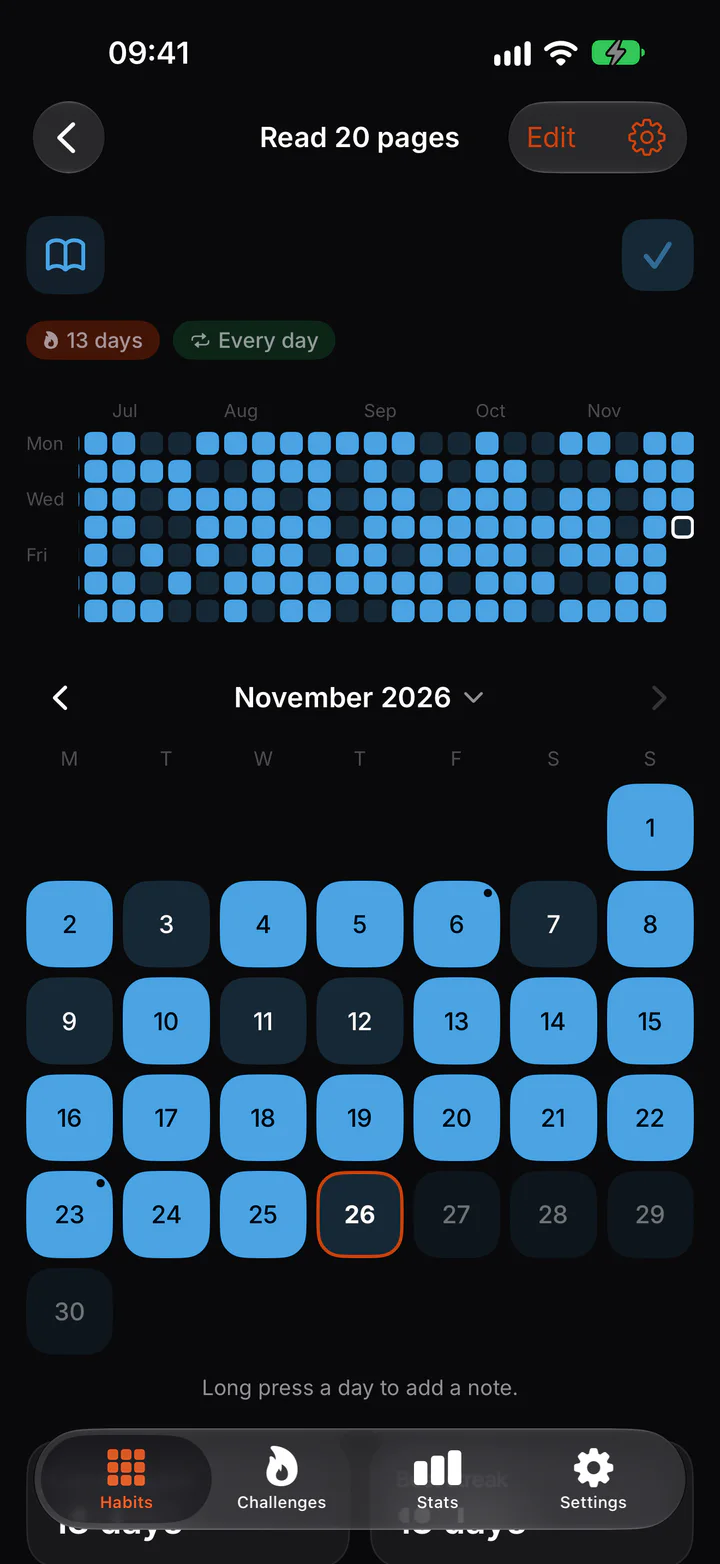
If you’d rather count, create the habit with “Counter” tracking and a goal of 20, or “Measure” with “pages” as the unit so you can enter the exact number each night. Your tiles will then be more or less filled depending on the day and, with “Measure,” a “Cumulative” total in pages appears on the habit’s page in the Stats tab. The trade-off is slightly longer logging. If it becomes a chore, go back to “Yes / No.”
Also set your rule for low-energy evenings. Mine would be: one page is enough to check it off, as long as I don’t use that twice in a row. You can choose something else, but decide it in advance. Without a rule, you end up negotiating with yourself at 11 p.m., and you often lose.
If you mostly read at night, a reminder around 8:30 p.m. can act as a signal. It stays quiet on days you’ve already checked off.
Keep notes on what you read
The grid records the days you read, and notes keep what you read: on the habit’s detail screen, “Today’s note” lets you write a line, and a long press on a past day lets you add one after the fact. “All notes” then gathers them into one list, and in the month calendar a small dot marks the days that have one.
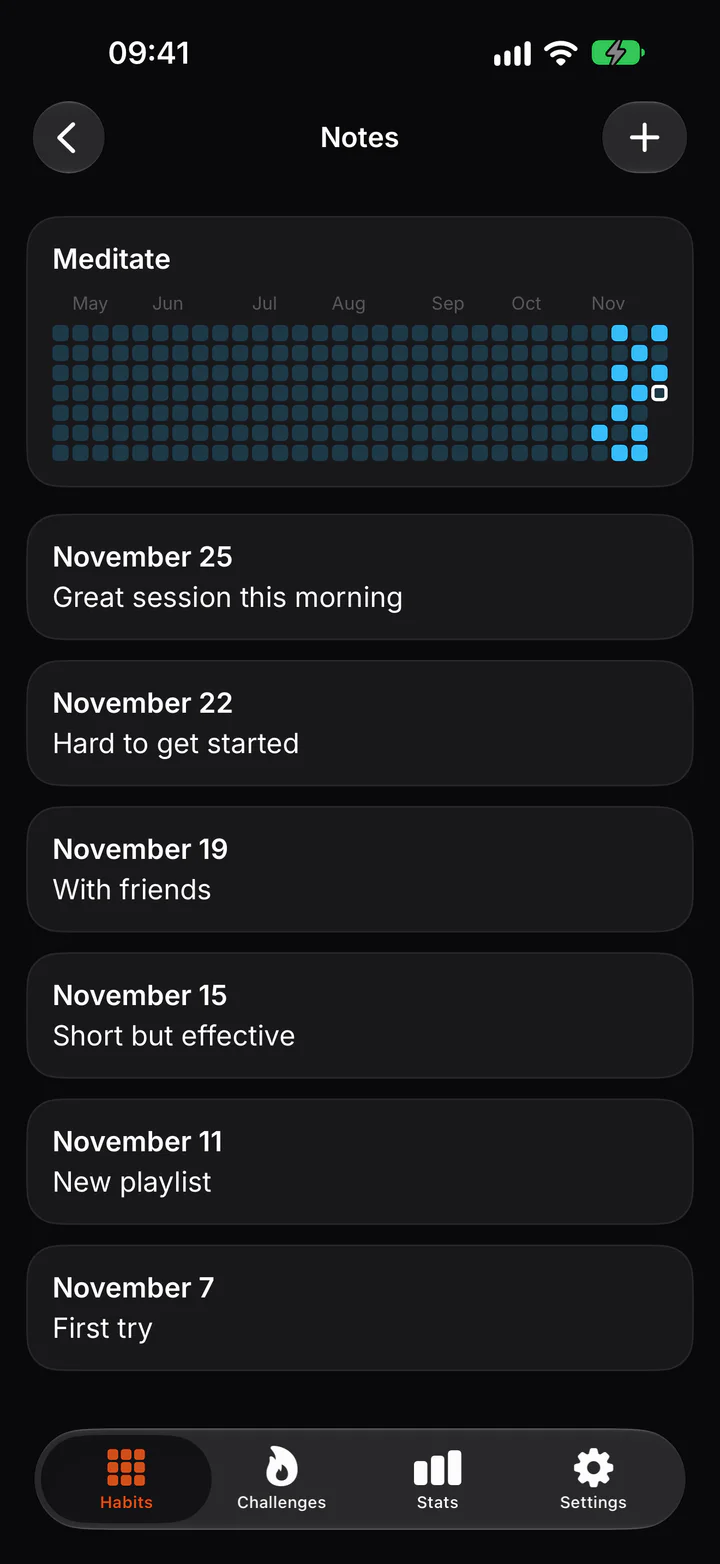
There’s no need for a book report. A few words will do: “Finished chapter 12,” “Read on the train,” “Finished the novel,” “Started a new book.” With these markers, at the end of the year you can see when you started and finished each book, and count how many you read without keeping a separate list.
You can add a sentence you want to remember, or the page where you stopped if you read without a bookmark. Keep it short. A note that takes more than a minute to write eventually stops getting written.
When the streak ends
It will end: a move, a busy week of vacation, a book you don’t like. The streak counter drops to zero, and that’s when many people give up, because the number that kept them going is gone.
Look at the grid instead. Three months of full tiles with a one-week gap are still three months of reading. The article on streaks and slips explains why that total matters more than the current streak, and the grid method shows how to read these patterns.
To get going again, lower the bar for a few days: five pages, an easy book, the same slot as before. Once you’re opening your book every night again, going back up to twenty pages is usually easy.
If reading keeps landing last in your day, you can also change the rule. In “Goal and streak,” “Times per week” lets you aim for five reading days out of seven. The two free days absorb the busy evenings, and your streak is then counted in successful weeks.
Frequently asked questions
How long does it take to read 20 pages?
It depends on the book and on you. Time yourself once on a book you’re reading now: count the pages you read in ten minutes and multiply. For a paperback novel, plan on half an hour if a page takes you a minute and a half. Dense nonfiction takes longer.
Should I count pages or minutes?
Pages are easy to check and give you a clear target. Minutes work better if your books vary a lot, or if you read on an e-reader. Pick one and stick with it: what matters is being able to say without hesitating whether the day is done.
Do audiobooks count?
That’s your rule to set. If your goal is to discover more books, yes. If you want to get back into the habit of reading and doing nothing else, keep audio for your commute and count only print or e-reader reading.
What if I haven’t read for a week?
Start again with an easy book and a smaller goal, five pages for example, for a few days. Your grid keeps everything you read before. One empty week in the middle of several months of reading doesn’t change much overall.

Track this habit in HabitLove
One grid per habit, with reminders and streaks. Free, no account needed.