What to Do After You Break a Habit Streak

The short answer
A streak counts your days in a row, and one missed day resets it to zero. That zero says nothing about the weeks before it: your grid keeps them all. After a slip, log it, pick up the next day with the same minimum, and look at your 30-day rate rather than the counter. If slips keep coming back, adjust how often or how much.
What a streak counts
A streak is the number of days in a row you’ve done your habit. It goes up by one with each successful day and falls back to zero on the first missed one. The number makes sense instantly and is fun to watch grow: at twelve days, you want to reach thirteen.
That pull is useful. On evenings when you hesitate, the thought of losing a forty-day streak is often enough to get you to open the book or roll out the mat. It also shows progress from the first week, when the real effects of the habit won’t appear for a while. The trouble is that it sums up your whole history in one number, and that number has only two states, “going” or “gone.”
The day after a missed day
You were at 47 days. Yesterday you got home late and forgot, and this morning the counter says zero. The next thought is a familiar one: “Well, I’ve blown it, I might as well quit.” One slice of cake becomes the whole box, one day without exercise becomes a month.
The counter encourages that reading, since it shows the same zero as if you’d never started. Yet the gap between a beginner and someone who has kept it up for 47 days out of 48 is huge. The habit has a place in your day, you know what time it fits best, and none of that vanished overnight.
In 2009, Phillippa Lally and her colleagues followed 96 volunteers for twelve weeks to measure how a daily behavior becomes automatic. They found that missing one opportunity did not materially affect the habit-forming process. What you do the next day counts for far more than the slip itself.
That finding is about a single day. Missing a whole week has consequences: the longer the break lasts, the more the habit loses the anchor it was tied to, and the more effort it takes to put it back in place.
Look at the grid before the counter
Your habit’s grid keeps every day, where the streak keeps only the end. After a slip, it shows 47 full tiles, one empty tile, and room for the next one. That’s a truer picture of where you stand than the zero on the counter, as the grid method explains.
Two other numbers help you keep perspective. The 30-day rate shows the share of successful days over the last month: with one missed day, it stays very high. The best streak never goes down. In HabitLove, each habit’s detail screen shows both next to the current streak.
Habits to quit and the “I slipped” button
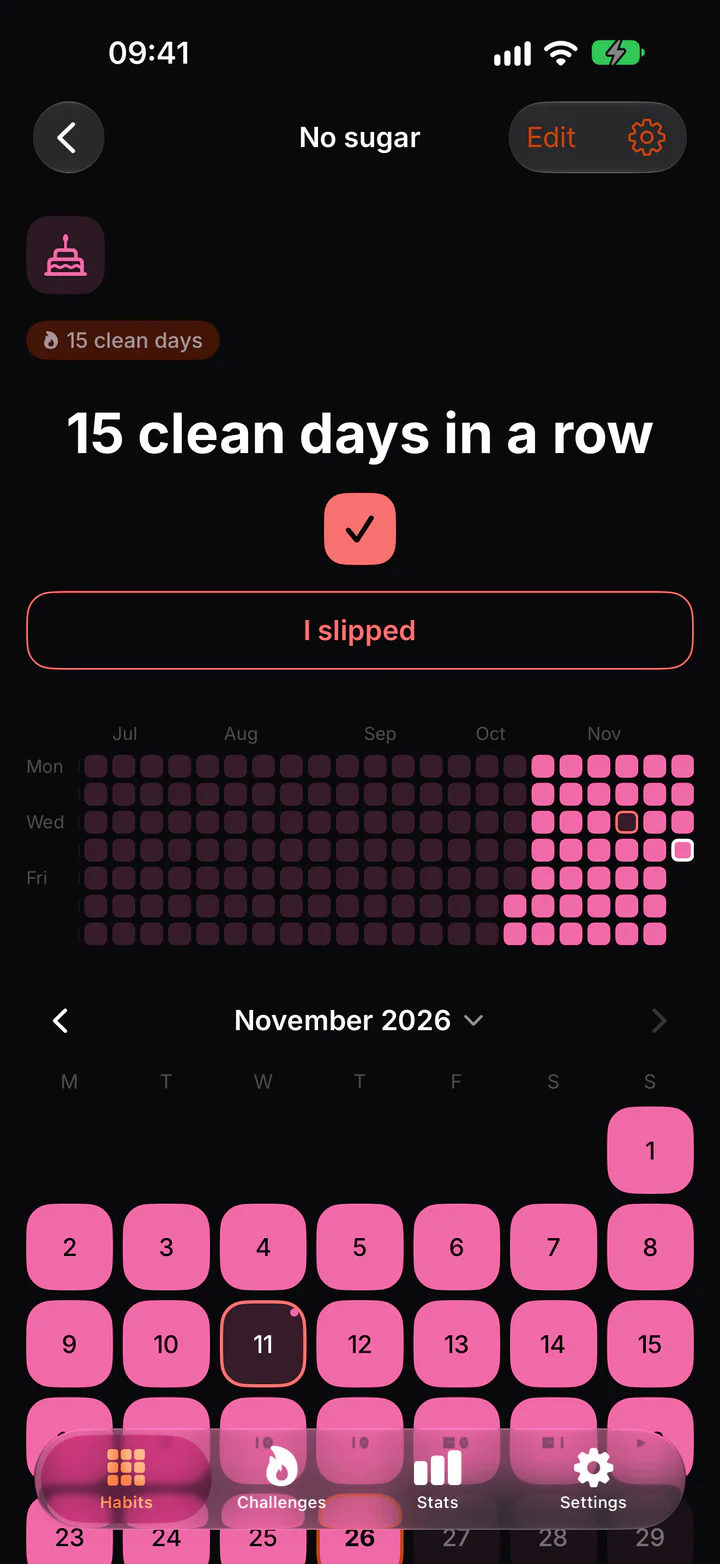
For a habit you’re trying to quit, like sugar or the late-afternoon coffee, a slip feels heavier. HabitLove handles these habits separately. Every day counts as clean by default, and you log only your slips with the “I slipped” button.
When you confirm, the app tells you what will happen: “Your streak restarts from zero, your grid stays. Tomorrow is a new tile.” The slip leaves a mark in the grid, which keeps everything else. You can add a note with the context (a birthday, a stressful day), which will help when you read back over your slips looking for something they have in common.
Log your slips honestly, even the ones you’d rather hide. Three slips that all land on a Friday evening tell you something precise about the moment to prepare for. The articles on quitting sugar and cutting back on coffee walk through this kind of reading for two common cases.
For tobacco, alcohol or any other dependence, a tracking app is no substitute for proper support. If slips keep piling up or you’re struggling, talk to your doctor or another health professional.
Set your streak so you can keep it
A streak that breaks often is sometimes set up wrong. A habit you can’t reasonably do every day shouldn’t be counted every day.
HabitLove’s “Goal and streak” screen offers several rhythms. With “Specific days,” your streak counts only the days you chose, and the others are free: they never interrupt it. With “Times per week” or “Times per month,” you set a number to reach over the period, and the streak can be counted in weeks or months. A week where you hit your goal adds a week to your streak, whichever days you did it on.
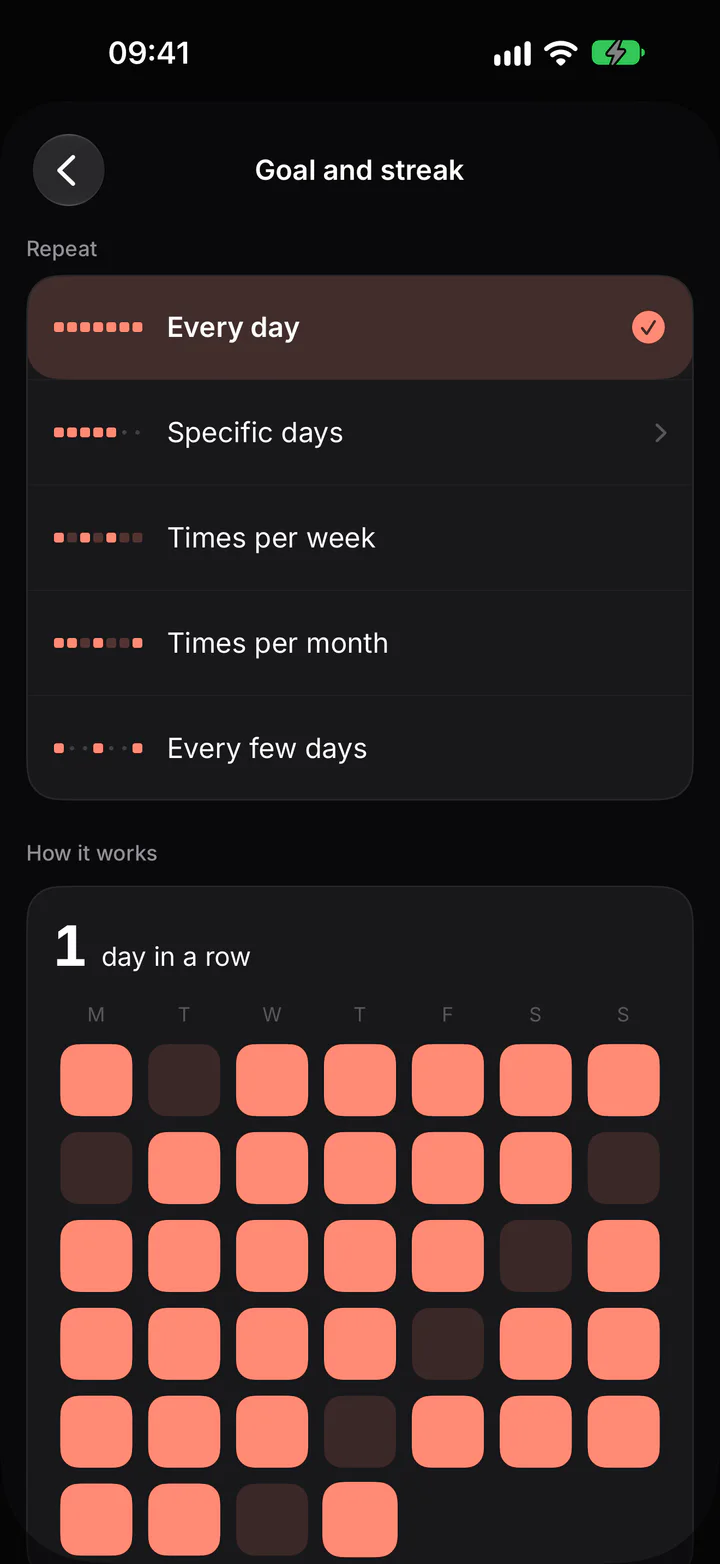
With that setting, a slip weighs much less. If you aim for four workouts a week, missing Tuesday breaks nothing, since you still have five days to fit in your four sessions. The article on weekly and monthly goals explains how to choose between these rhythms.
For a habit to quit, you can also suspend tracking for a while with “Pause tracking,” in the menu of its detail screen, and resume it whenever you like.
A plan for the day after
Once the slip has happened, the aim is to keep it from turning into giving up. Start by logging it right away: leave the square empty, or tap “I slipped” for a habit to quit. An accurate grid will serve you later, when you read back over your slips.
Write one line about what happened, with the time, the place and how you felt, without trying to analyze it. A month from now, three notes like that side by side may show that your slips all fall on Friday nights.
Pick up the next day with your usual minimum, without doubling the dose to punish yourself. If the normal version feels too heavy that day, do the smallest possible version, two pages or three minutes, and check it off.
Watch the second day. One missed day is an accident, while two in a row start to look like a new habit, the habit of not doing it. If you have to choose where to put your effort, put it into not missing twice in a row.
If slips come back every week, change the rule. Lower the amount, move the habit to another moment, or switch to a weekly rhythm.
When a long streak makes sense
Long streaks have their place. For a very short action, like flossing or drinking a glass of water when you wake up, aiming for every single day is realistic. HabitLove lets you set a “Streak goal,” which the habit’s card can show as “12 / 30,” to give yourself something to aim for.
For everything else, treat the streak as one number among several. It pushes you on ordinary days, and when it breaks, your grid and your 30-day rate take over.
You can try these settings in HabitLove, which is free and needs no account.
Frequently asked questions
Does one missed day undo a habit?
No. In the study by Lally and colleagues published in 2009, missing one opportunity did not materially affect habit formation. What matters is a run of missed days, because the habit then loses its place in your day.
Should I make up for a missed day by doing double the next day?
It’s better to go back to your usual amount. Doubling turns the next day into a punishment and makes it harder to restart. The missed day stays empty in the grid, and the next one fills in as usual.
How do I keep a streak from becoming a source of stress?
Choose a rule you can keep without cheating: specific days only, a number of times per week, or a streak counted in weeks. Free days then interrupt nothing, and one hard day doesn’t call everything into question.
What happens in HabitLove when I log a slip?
For a habit to quit, the “I slipped” button marks the day as a slip. The streak restarts from zero, the grid keeps every clean day before it, and tomorrow is a new tile. A slip logged by mistake can be undone.
Sources

Track this habit in HabitLove
One grid per habit, with reminders and streaks. Free, no account needed.