Weekly and Monthly Habit Goals: Beyond “Every Day”

The short answer
A habit doesn’t have to be daily. For exercise, aim for a number of times per week. For things that come around rarely, like calling someone close, count by the month. For spaced-out tasks, like watering the plants, choose an interval of a few days. Your streak is then counted in weeks or months, and a day off breaks nothing as long as you meet the goal for the period.
Daily doesn’t suit everything
Habit advice almost always says “every day.” For drinking water or reading a few pages, that’s the right rhythm. For other activities, the rule all but guarantees failure.
Running needs rest days, and the pool has its own hours. Deep cleaning the house doesn’t happen on a Tuesday night after work. Calling your grandmother every day would feel strange to both of you. If you track these activities with a daily box, what you mostly see is empty boxes, even though you’re doing exactly what you planned.
So before you track a habit, ask yourself what rhythm makes sense for it. Most of the time, the answer is one of four cases: fixed days, a number of times per week, a number of times per month, or an interval of a few days.
Specific days: when the calendar decides
Here you know the days in advance. Yoga class is on Tuesday and Thursday, you practice your instrument on days without a lesson, you brush up on your Spanish on weekdays.
In that case, choose “Specific days” and check the days you want. HabitLove offers shortcuts for common cases, “Weekdays” and “Weekends.” Your streak then counts the chosen days in a row. The other days are free: they never interrupt the streak and don’t lower your consistency. If you do the habit on a free day anyway, it shows in the grid and counts toward your total.
This rhythm works when the activity depends on an outside schedule. It works less well when your schedule shifts from week to week, because a missed Monday stays missed even if you catch up on Tuesday.
Times per week: a number, and free days
You set a quantity and choose the days as the week goes: three workouts, four evenings without screens, two review sessions. HabitLove accepts one to seven times per week.
Of all the rhythms, this is the most forgiving. A meeting that runs late on Tuesday costs nothing, since the session can move to Wednesday. The habit’s detail screen shows where you are, for example “2 of 4 this week,” which tells you on Thursday whether you need to fit in a session before Sunday.
The risk is pushing everything to the weekend, then having to cram three sessions into two days. To avoid that, keep a set day for the first session, often Monday or Tuesday. Once the first one is done, the others are easier to place.
To know how many to aim for, start from what you already do. If you run once a week, aim for two, not five. The article on push-ups and exercise shows how to build up from there in small steps.
Times per month: for what comes around rarely
Some things matter to you and only come around a few times a month: calling someone close, going for a hike, doing your budget, cooking a real meal for friends. Tracked by the week, they leave empty weeks that mean nothing. Counted by the month, they get a fair measure.
Choose “Times per month” and a number between 1 and 31. With a goal of five calls a month, the detail screen shows your progress, “2 of 5 this month,” and around the 20th you know whether you’re on track.
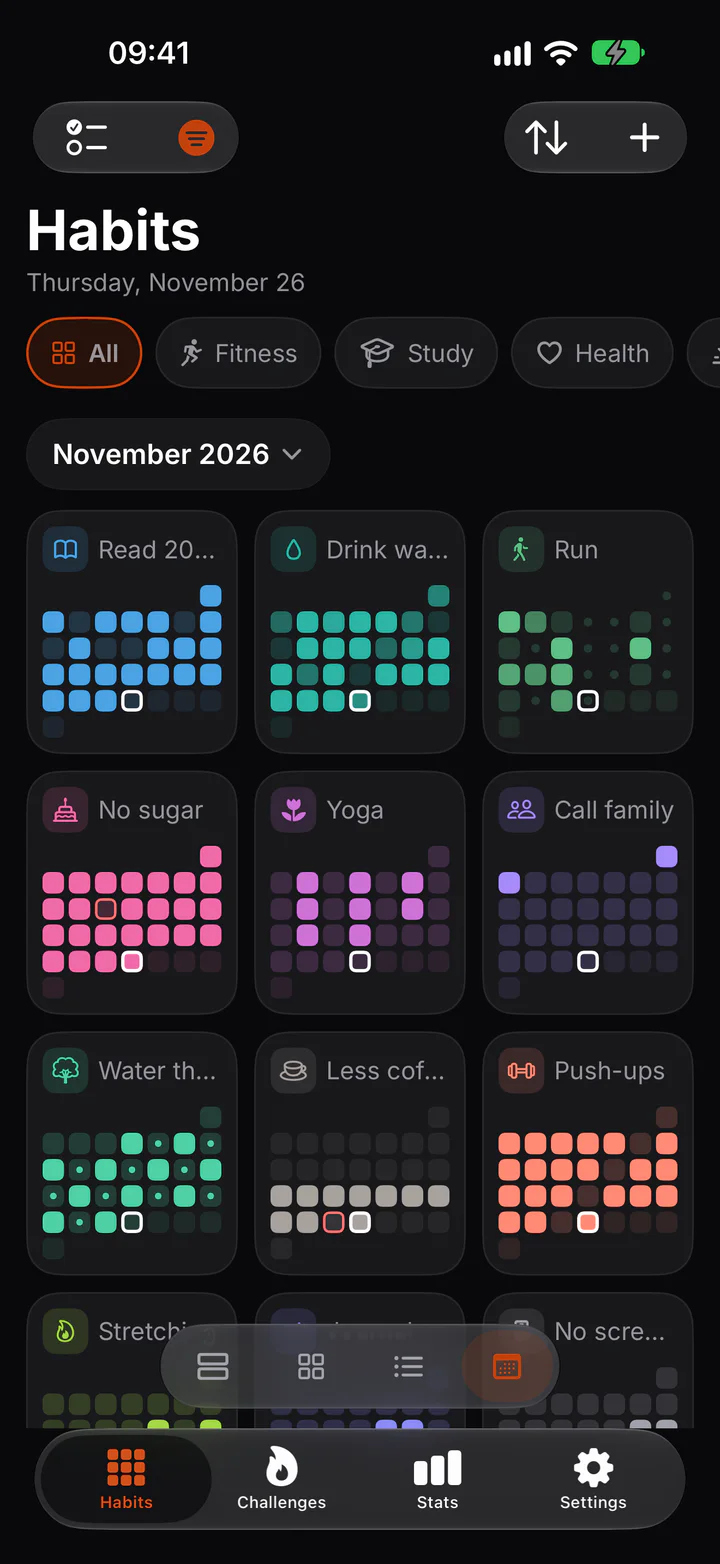
The Month view of the Habits tab is handy for these habits. It shows a calendar for each habit, with the completed days standing out, so a month that fills up early or late stands out right away.
Every few days: for spaced-out tasks
The last rhythm is for tasks that need to come back regularly without a fixed day: watering the plants, changing the sheets, doing laundry, weighing yourself. What you mostly want is to avoid letting too much time pass between two rounds.
With “Every few days,” you choose a gap of 2 to 30 days, and the rule becomes: check it off at least once in that window. If you water on a Sunday with a three-day interval, you have until Wednesday to do it again.
Counting the streak in days, weeks or months
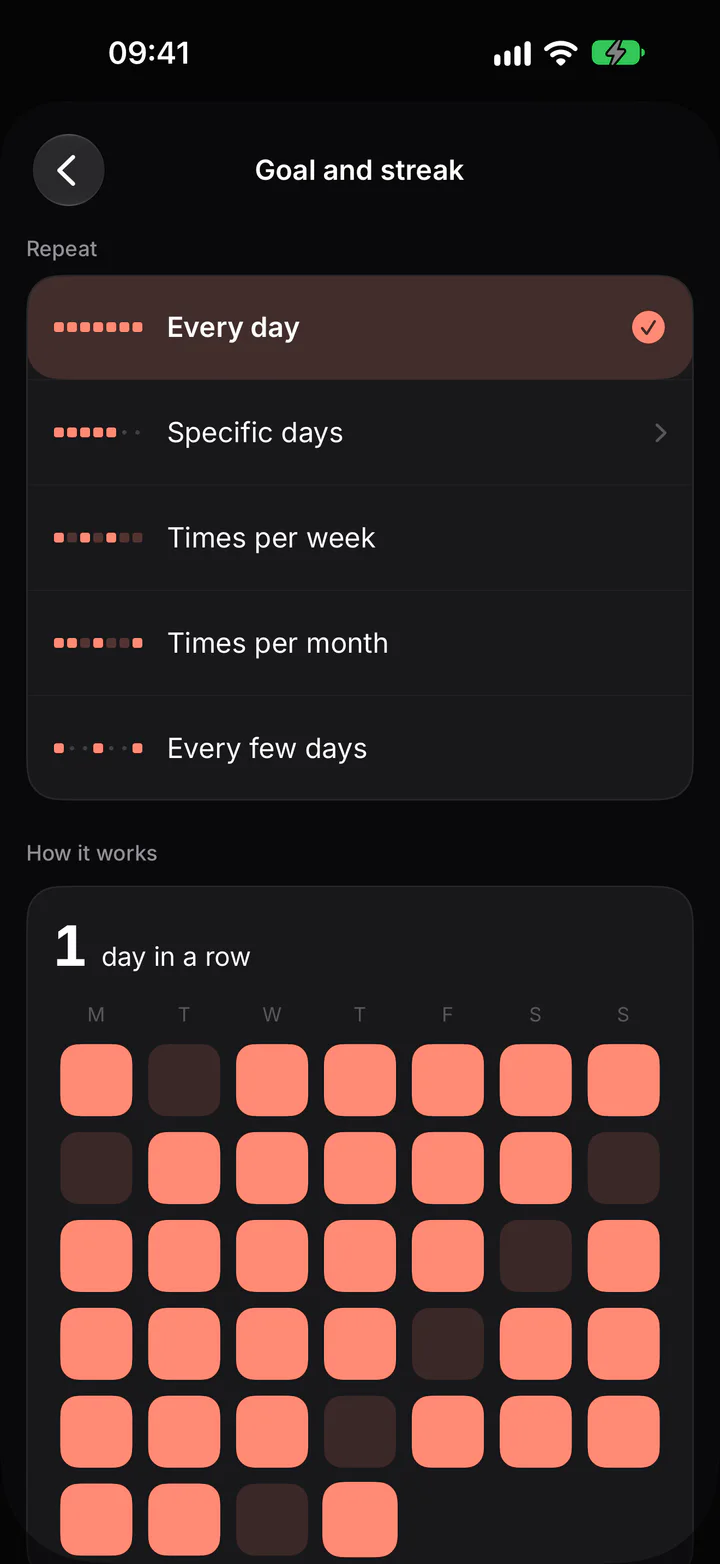
Once you’ve chosen the rhythm, you decide what your streak counts. HabitLove asks you directly: “Count my streak in” days, weeks or months.
In weeks, each week where you meet or beat your goal adds one week to the streak. Twelve weeks in a row at three sessions give you a streak of twelve, and you no longer wonder whether Thursday’s rest day broke anything. Counting in months works the same way, one month at a time.
In days, the streak counts each day you do the habit, as long as the goal for the week or month is met. That’s useful if you like seeing a big number, but it’s harder to read at a glance.
For most weekly habits, a streak in weeks is the easiest to read. It also spares you the urge to give up after a day off, which the article on streaks and slips talks about.
A grid that stays readable
With a goal of three times a week, a daily grid always has four empty squares a week, and eventually you can’t tell a good week from a bad one.
HabitLove has an option for this: “Fill when the weekly goal is met.” As soon as you reach your goal, the other days of the week get a small mark showing that the period is done. The same option exists for the month and for intervals. A successful week then shows up as a full column, and a missed week keeps its gaps.
Before you save, the screen also shows a preview of your last six weeks with the new goal. You can see right away whether the rhythm you chose matches what you actually do, or whether it’s too ambitious.
How to choose, in practice
Start from the action. If it takes less than five minutes and isn’t tiring, keep it daily: repeating it every day is what makes it automatic fastest, as described in how to build a habit that sticks.
If it depends on a fixed schedule, pick “Specific days.” If it takes energy or recovery and your calendar moves around, pick “Times per week.” If it comes around less than once a week, pick “Times per month,” and for regular upkeep with no set day, the interval.
Start low. A goal of twice a week met for two months beats a goal of five dropped after three weeks. You can raise it later: past days keep their former goal, so raising it doesn’t devalue what you’ve already done.
Finally, check your choice after a month. If you beat the goal every week without effort, go up a notch. If you miss it every other week, come down a notch. The weekly review is the right moment for that adjustment.
All these rhythms are available in HabitLove, on each habit’s “Goal and streak” screen.
Frequently asked questions
Is it better to do a habit daily or three times a week?
It depends on the action. A short action that needs no recovery, like reading a few pages, works well daily. An activity that tires you out or depends on a place, like running or swimming laps, holds up better with a number of times per week.
What’s the difference between “Specific days” and “Times per week”?
With “Specific days,” you set the days in advance, for example Monday, Wednesday and Saturday, and only those days count. With “Times per week,” you set a number and place the sessions wherever you like in the week.
How does the streak work with a weekly goal?
You can count it in weeks: each week where you meet or beat your goal adds one week to your streak. The free days of those weeks don’t count against you.
What happens to my history if I change my goal?
In HabitLove, days before today keep their old goal, and the new one counts from today. Going from four to three times a week doesn’t rewrite your past weeks.

Track this habit in HabitLove
One grid per habit, with reminders and streaks. Free, no account needed.