Daily Push-Ups: Get a Little Better Every Day

The short answer
Start with a number you can do with good form even on a bad day, count it every day, and only raise it after two weeks without struggling. Go up in small steps, from 8 to 10 for example. A counter with a daily goal is enough to track it, and the number of complete days per month shows your progress better than your best single session.
Why a small number every day
Workout plans often fail because they need an hour, the right clothes, a place and energy, four things that rarely line up on a Wednesday night. Push-ups need none of them. A few square feet of floor and one minute are enough, which makes them a good exercise for building a movement habit.
The math favors small numbers. Ten push-ups a day for a year adds up to more than 3,600 push-ups, while a heroic session now and then, followed by ten days of nothing, adds up to a few hundred.
If you haven’t exercised in a long time, or if you have a back, shoulder or wrist problem, or a heart condition, ask your doctor before you start. And whatever your level, sharp pain during the exercise is a signal to stop.
Find your starting number
Do a test on a day when you feel good. Count the most push-ups you can do in a row while keeping your body in a straight line, your chest coming down close to the floor and your arms straightening at the top. Stop as soon as your form breaks down, without grinding out one last crooked rep.
Your daily goal sits at about half of that max. If you tested at sixteen, aim for eight; if you tested at four, settle for two. The number should feel almost too easy: you need to be able to do it after a bad night’s sleep, when you get home late, without any elaborate warm-up.
If a regular push-up isn’t possible yet, keep the idea and change the version. Push-ups on your knees, or with your hands on a coffee table, take less strength, and you count them the same way. Move to the floor version when the easy one no longer costs you anything.
Pick your moment
One minute fits anywhere, which is exactly why it gets pushed back until bedtime. Give it an anchor: before your morning shower, while the pasta water heats up, when you come back from lunch. Before the shower has one advantage: you won’t have to worry about sweating into your work clothes.
You can also split it up. Eight push-ups as two sets of four, morning and evening, give the same total. Splitting helps once the number grows: twenty push-ups in a row is a lot, while four sets of five spread over the day go by without much thought. If you already have a morning routine, push-ups can be its last step before the shower.
Count and take notes
Without a count, you don’t know where you stand, and you have nothing to tell you when to move up. In HabitLove, you set up this kind of habit with “Counter” tracking and a daily goal. Call it “Push-ups” and give it your current number, 10 for example.
By default, each tap on the habit’s button adds one, which works for glasses of water but much less for ten reps. For push-ups, set “On tap” to “Enter the total” in the habit’s form instead. Every tap then opens the editor, where you type the number, add five at once, or set the full goal once your set is done. A long press opens the day sheet, with the − and + buttons and a note. The day’s tile fills in proportion: a day at six out of ten leaves a lighter tile than a complete day, where “Yes / No” tracking would have left it empty.
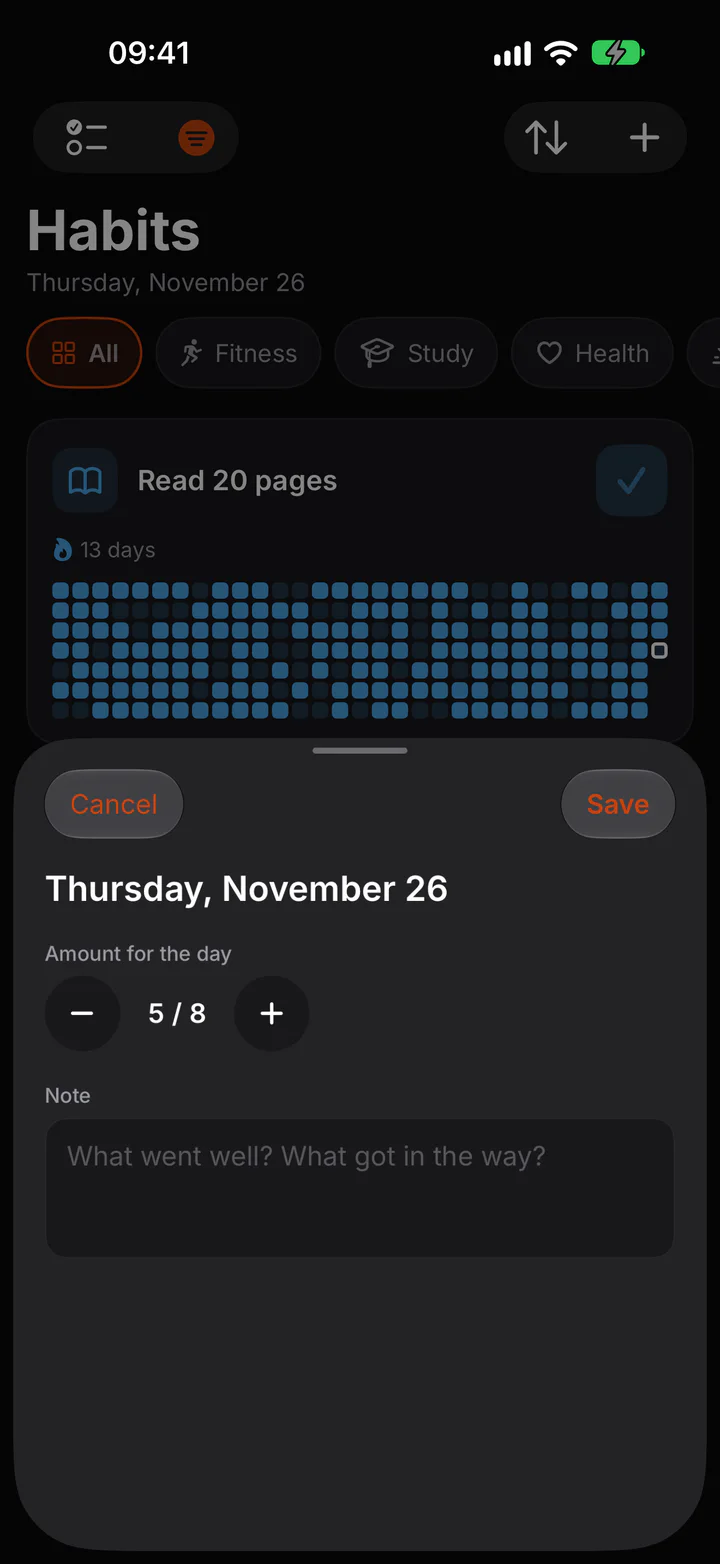
Use the note on this sheet for days that stand out: “right shoulder sore,” “did it in two sets,” “first set without knees.” These markers will help you understand a dip or put a date on a breakthrough.
Move up in steps
The safest approach is to wait until your goal starts to bore you. When your number has felt easy for two weeks, with a full grid, add one or two reps. From 8 to 10, then from 10 to 12. Bigger jumps tend to give you one good day followed by three skipped ones.
In the app, you change the goal inside the habit. Days before today keep their old goal, and the new one counts from today. Raising the bar doesn’t leave last month’s grid half empty: a month spent at 8 is still a successful month, even after the goal goes up to 10.
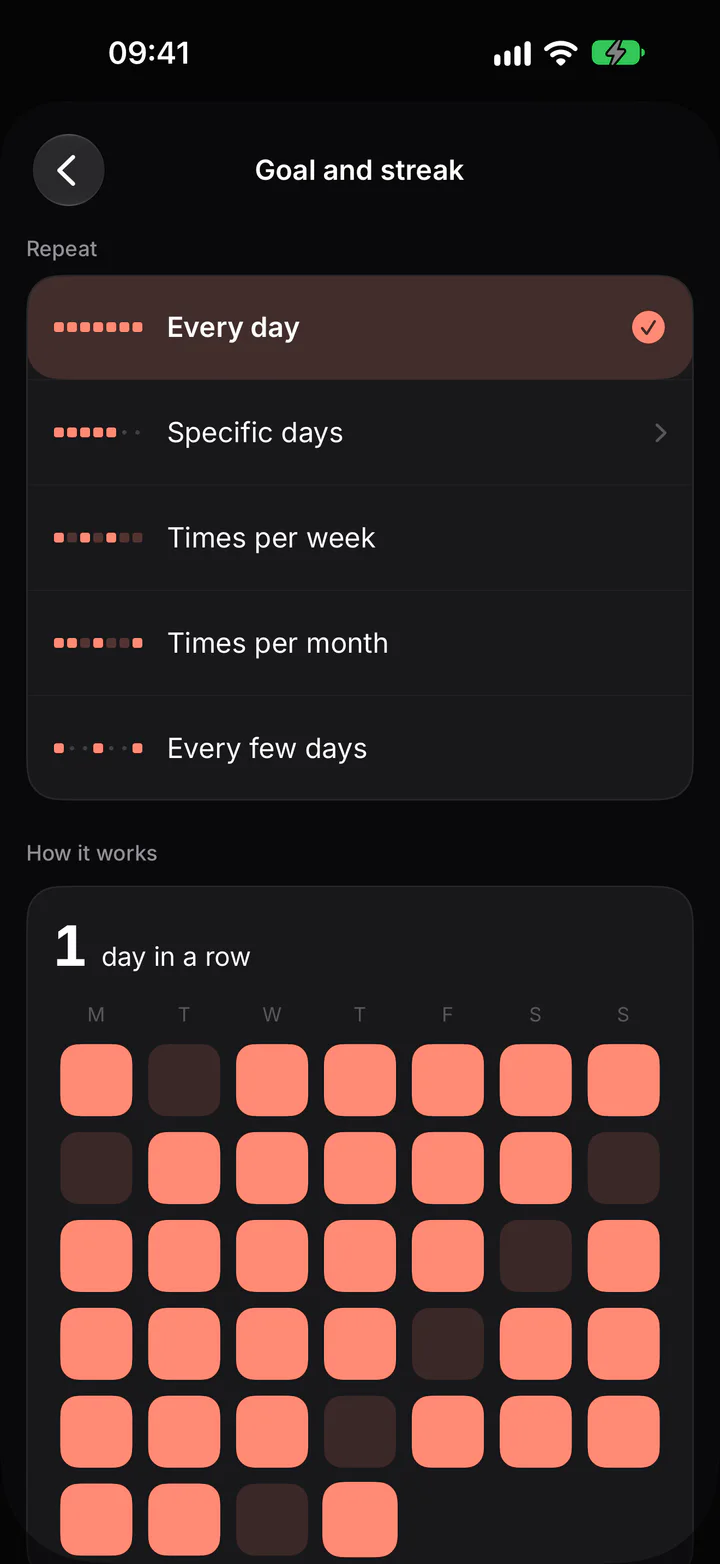
Further down, the same screen offers a “Streak goal,” a streak to reach, 30 days for example. It helps if a target motivates you. Set it when you move to a new step: thirty days at the new number, then decide what comes next.
If the new step makes you skip days, go back down. Returning to 10 after two rough weeks at 12 tells you where your limit is right now. You can try 12 again in a month.
Rest days and busy weeks
Not everyone handles daily exercise, even light exercise. If your shoulders or wrists complain, switch to a schedule with rest built in. The “Goal and streak” screen lets you do this in two ways: “Specific days” to pick, say, Monday, Wednesday and Friday, or “Times per week” to aim for four or five sessions without fixing the days. Either way, your days off don’t break your streak. The article on weekly and monthly goals goes into how to choose between them.
For weeks when you’re sick or traveling, keep a minimum version: a single push-up, or ten seconds of plank. If you know you’re stopping for a while, after an injury for example, archive the habit from its menu: its grid is kept, and you unarchive it when you start again.
Look at the month
Once a week or once a month, open the Stats tab and swipe to your habit’s page. You’ll find the grid for the year, the total of successful days, the success rate, the current streak, the best streak and the “Completions per month” chart. For a counter, a day counts as a success when the goal is reached. So the chart tells you how many complete days you did each month.
If you also want the sum of all your reps, create the habit with “Measure” tracking and a unit, “push-ups” for example, instead of the counter. The habit’s page then shows a “Cumulative” figure for the year. For an exercise you count, that’s the most telling number, because it also adds up the incomplete days.
Compare months with each other and leave single days alone. A Tuesday with four push-ups means nothing, while twenty-six complete days in March after nineteen in February show that the new number has settled in. If you already do a weekly review, add a look at this page: ten seconds is enough to know whether you stay at the same number or move up.
Once push-ups are automatic, you can add a second exercise on the same model, squats or planks, with its own counter. Wait until you do the first one without having to think about it, as with any new habit: one at a time.
Frequently asked questions
How many push-ups a day should a beginner do?
Do a test: the most clean push-ups you can do in a row, without forcing the last one. Take roughly half of that as your daily goal. If you manage ten in the test, five a day is a good start. If a regular push-up is too hard, start on your knees or with your hands raised.
Should I do push-ups every day or take rest days?
With a small number well below your max, many people do them every day without trouble. If you feel soreness that lingers or pain in a joint, switch to every other day, or five days a week. If the pain doesn’t go away, see a doctor or a physical therapist.
When should I raise the number?
When your current goal has felt easy for about two weeks and the last rep still has good form. Add one or two push-ups at most. If the new number makes you skip days, go back to the previous one.
How do I track push-ups in HabitLove?
Create a habit with “Counter” tracking and your daily goal. With “On tap” set to “Enter the total,” a tap opens the editor where you enter your reps, in one go or in several. When you change the goal, past days keep the old one.

Track this habit in HabitLove
One grid per habit, with reminders and streaks. Free, no account needed.