How to Cut Down on Coffee: Set a Daily Limit and Stick to It
The short answer
Count your coffees for a week without changing anything, then set a daily limit just under your average. Drop the latest cup first, replace it with another drink, and lower the limit by one cup once the current one has held for two weeks. If you’re pregnant, have a heart problem or take medication, ask a health professional for advice.
Why aim for a limit
Most people who want to “quit coffee” have no wish to give up their morning cup. They feel they drink too much, that the 5 p.m. cup keeps them up at night, or that they get through four at the office without really wanting any of them. For them, a daily limit is enough, and quitting outright wouldn’t add much.
A limit has another advantage over quitting: it doesn’t break at the first slip. With “zero coffee,” a single cup ruins the day. “Two at most” gives you some room, and each day’s question comes down to a simple count.
On the health side, I’ll stick to what the European Food Safety Authority (EFSA) says on its caffeine page: taken close to bedtime, caffeine may shorten sleep in some adults. EFSA also gives a specific daily guide for pregnancy. If you’re pregnant or breastfeeding, have a heart problem or anxiety, are taking medication, or can’t cut down despite several attempts, talk to your doctor, midwife or pharmacist. They can give you guidance that fits your situation.
Count for a week without changing anything
Before you set a limit, you need your starting point. It’s easy to underestimate how much you drink, because the cups you have in meetings or at the office machine don’t stick in your memory.
For seven days, drink as usual and log each coffee when you have it. Decide first what you’re counting: one cup, whatever its size, is the simplest unit. If you drink large mugs or double shots, you can count them as two. Count the same way all week.
At the end of the week you have an average and, more useful still, the times. You’ll probably see two kinds of coffee: the ones you look forward to, and the ones you drink because the machine is on your way or a coworker offers. The second kind goes first.
Set the limit and choose the cup to drop
Take your average and subtract one cup. If you drink five a day, your first limit is four. A limit of two from day one, when you’re starting from five, rarely lasts more than a week.
Then name the cup that goes. Saying “four instead of five” without saying which one leaves you making the decision five times a day. Choose the latest one: based on what EFSA says about evening caffeine, it’s the most likely to disturb your sleep, and it’s often the one you drink on autopilot.
A cutoff time works well alongside the number. “No coffee after 2 p.m.” takes one glance at the clock to check and protects your evening, whatever the morning’s count.
Replace the ritual
A coffee does several things at once: it’s a break, a warm drink in your hands, a reason to get up and talk to someone. If you drop the cup and put nothing in its place, you lose all of that at once, and the craving comes back at the same time the next day.
So keep the break and change what’s in the cup. Decaf, herbal tea, a big glass of water: pick whatever makes you miss coffee the least. Water has the advantage of feeding another habit at the same time, the one described in the article on a water reminder. If your 4 p.m. coffee came with a cookie, keep an eye on what happens to the cookie too, because the two habits often go together: the article on sugar covers that.
Think about places as well. If the office machine is on the way to the restroom, you’ll walk past it six times a day, and you can’t move it. So arrive with your water bottle or your mug of herbal tea already full, and you’ll walk past without stopping.
Track a limit with a counter
You track a limit with a counter that works the opposite way from a goal: you want to stay under it. In HabitLove, you create a habit of the “Quit” type with “Counter” tracking for this. The form then shows the “Stay under” field, where you enter your daily limit. The app’s help text sums up the rule: “The day stays a success as long as you stay under this limit.”
Take a “Less coffee” habit with a limit of 2. Each tap on its button adds one coffee, and the app shows where you stand against the cups allowed today. As long as you don’t go over the limit, the day counts as clean. Beyond it, it counts as a slip. Three days at 1, 2 and 3 coffees give you two clean days and one slip.
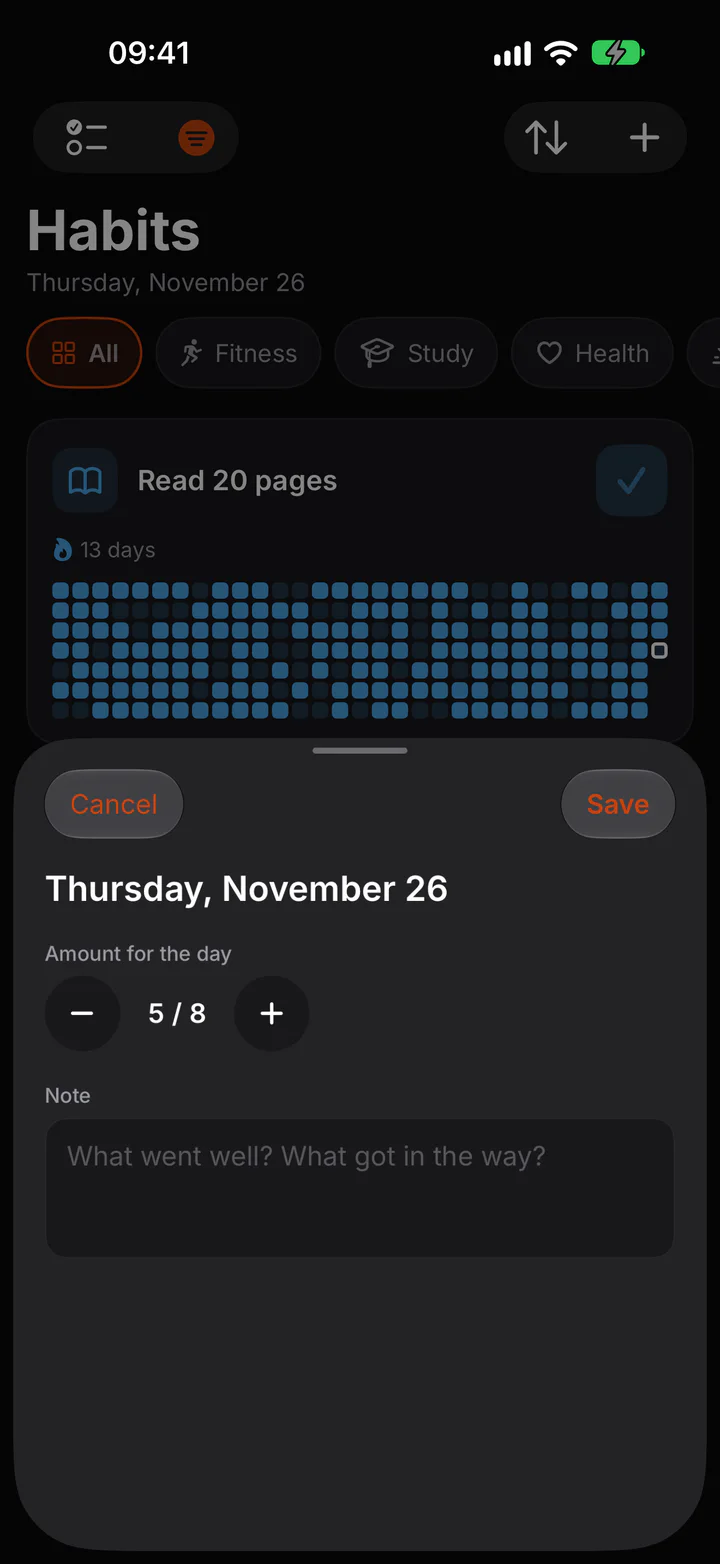
A habit to quit is tracked every day, and a day where you logged nothing counts as clean. For the count to be right, log each coffee as you drink it. A widget on your Home Screen or your Apple Watch saves you from opening the app for every cup.
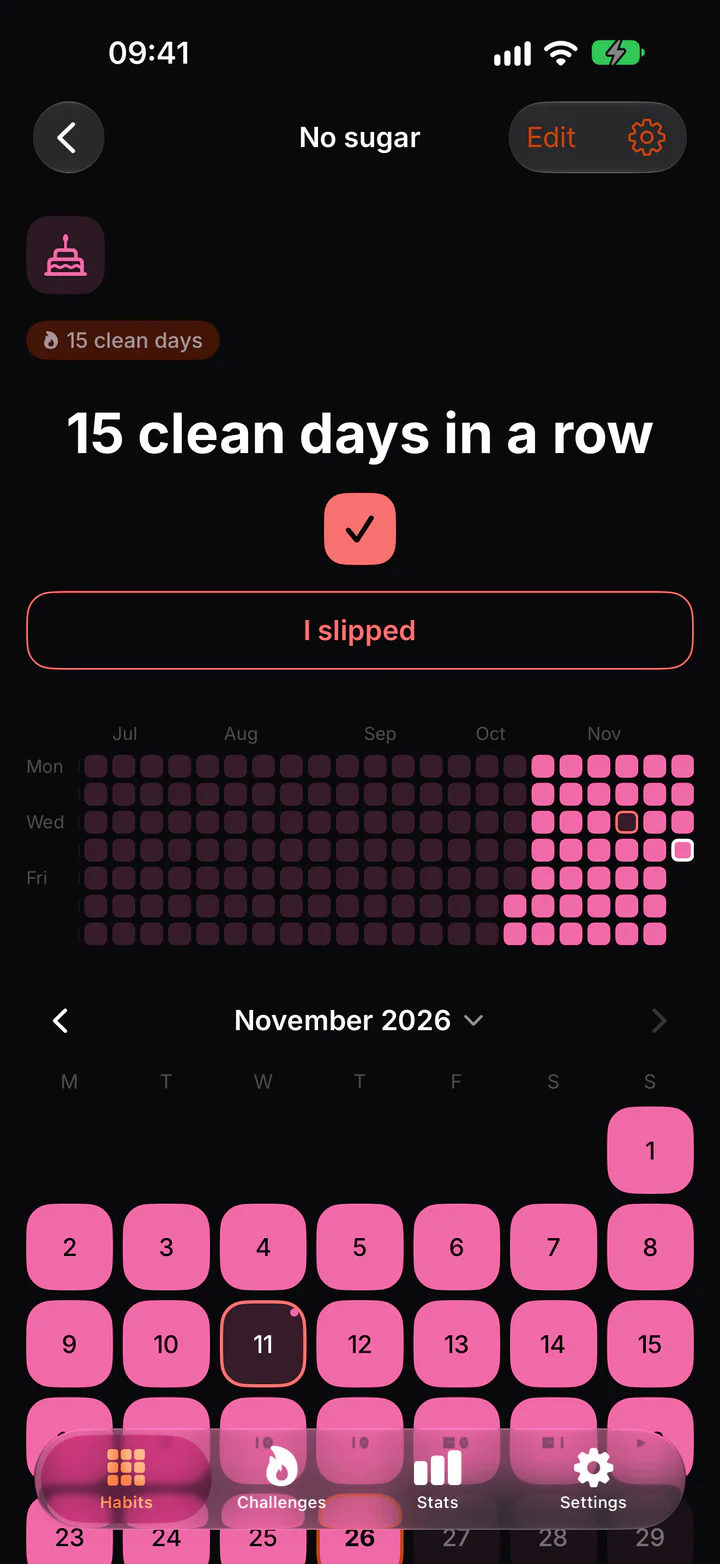
The habit’s detail shows the clean days in a row and the grid. A day over the limit shows up there as a slip, without erasing the others. You can add a note: “short night,” “three-hour meeting,” “someone bought me one.” These notes will tell you which situations blow your limit.
Lower it one notch
When your current limit has held without effort for two weeks, lower it by one cup. From four to three, then from three to two if you want to go that far. You change the “Stay under” field in the habit. Past days keep the old limit, and the new one applies from today, so a four-coffee day last month is still a clean day.
Stop at the level that suits you. Nothing says you have to get to zero, and many people settle at one or two cups in the morning. If a step costs you too much, if you sleep badly, get irritable or notice symptoms that worry you, go back up one notch and talk to a health professional before you try again.
Days over the limit
You’ll have some: a Monday after a bad night, a day at a conference with free-flowing coffee. One day at four when your limit is three doesn’t take you back to where you started. Log it and return to your limit the next day, without trying to make up for it with a zero-coffee day.
Look instead at how those days are spread out. If they always fall on Mondays, the problem probably comes from Sunday night and the time you go to bed, a topic covered in the article on evening screens. If they outnumber your clean days, the limit is too low for now: raise it by one cup and give it a month. For the rest, the article on streaks and slips explains why one bad day counts for little next to three good weeks.
Frequently asked questions
Should I quit coffee cold turkey or gradually?
Cutting down step by step is easier to keep up as a habit: you change one cup at a time, and you keep the ones you care about. If you want or need to stop completely for a medical reason, work out how with your doctor.
Which cup should I cut first?
The latest one, usually the afternoon or evening cup. EFSA notes that caffeine taken close to bedtime may shorten sleep in some adults. It’s also a cup people often drink out of habit more than desire.
Do tea and decaf count toward my limit?
You set the rule. If your goal is to cut down on caffeine, tea contains some and deserves to be counted, while decaf can serve as a replacement. If your goal is just to drink less coffee, count only coffee. Write your rule down so you don’t renegotiate it every day.
How do I track a coffee limit in HabitLove?
Create a habit of the “Quit” type with “Counter” tracking, and set the limit in “Stay under.” Each tap adds one coffee. The day stays a success as long as you don’t go over the limit, and counts as a slip beyond it.
Sources

Track this habit in HabitLove
One grid per habit, with reminders and streaks. Free, no account needed.