How to Drink More Water, With an Hourly Reminder
The short answer
People forget to drink because nothing reminds them during a busy day. Set yourself a number of glasses, keep a water bottle where you can see it, and schedule a repeating reminder, for example every hour from morning to evening. Log each glass with one tap. The reminder goes quiet as soon as you reach your goal for the day.
Why we forget to drink
A glass of water takes ten seconds and no effort. If you don’t drink enough, it’s rarely a lack of willpower: you just don’t think of it. Thirst shows up late in a busy day, and it’s easy to mistake for tiredness or the urge to snack. Between meetings, you get up for a coffee, rarely for a glass of water.
Habits that stick are triggered by a signal: a time, a place, an action that comes right before. Water has no moment of its own, since you drink it throughout the day, and that’s what makes it hard to turn into a habit. So you have to create signals for it: a bottle in sight, a few fixed moments and a reminder.
How much to aim for
No number works for everyone. The UK’s National Health Service, the NHS, gives 6 to 8 cups or glasses of fluid a day as a guide for most people. It says water, lower-fat milk and lower-sugar drinks all count, tea and coffee included, and that some of your fluid also comes from food. It adds that you need more in hot weather, during long physical activity, when pregnant or breastfeeding, and when you’re ill or recovering.
To check where you stand, the same source suggests a simple test: drink enough that your urine is pale yellow.
If you have kidney or heart disease, take medication that affects your body’s water balance, or have instructions from your doctor about how much to drink, those instructions come before anything you read here.
For the habit itself, choose a goal you can count without thinking. A glass is a good unit if you drink at the table or at your desk. If you carry a water bottle, count bottles: two refills are easier to keep track of than eight glasses. Then stick to the same unit every day, or your numbers won’t compare from one week to the next.
Also decide what you count. Some people log every drink, others only water, because the rule is simpler and spares you from wondering whether a latte counts as a glass. Both approaches make sense. If you’re unsure, count water alone for the first month.
Keep water in sight
Before you set up any reminder, arrange your surroundings. A full bottle next to your keyboard empties almost by itself, while one tucked away in your bag stays full until evening. Fill it when you arrive in the morning, then again after lunch.
Add two or three fixed moments that don’t depend on any reminder: a glass when you get up, before coffee, a glass with each meal, a glass when you get home. The morning glass fits into a morning routine without making it longer. These moments already cover waking up, meals and coming home, so the reminder is only needed during work hours, which is when the forgetting happens.
Set up an hourly reminder
A single reminder at 10 a.m. isn’t enough for a habit that repeats throughout the day. In HabitLove, when you add a reminder from a habit’s “Reminders” screen, you get two kinds: “At a set time” or “Several times a day.” The second opens the “Repeating reminder.” There you set three things: the interval (“Every hour” or another), the start time and the end time. The screen shows how many reminders a day that adds up to, so you know in advance how often your phone will buzz.
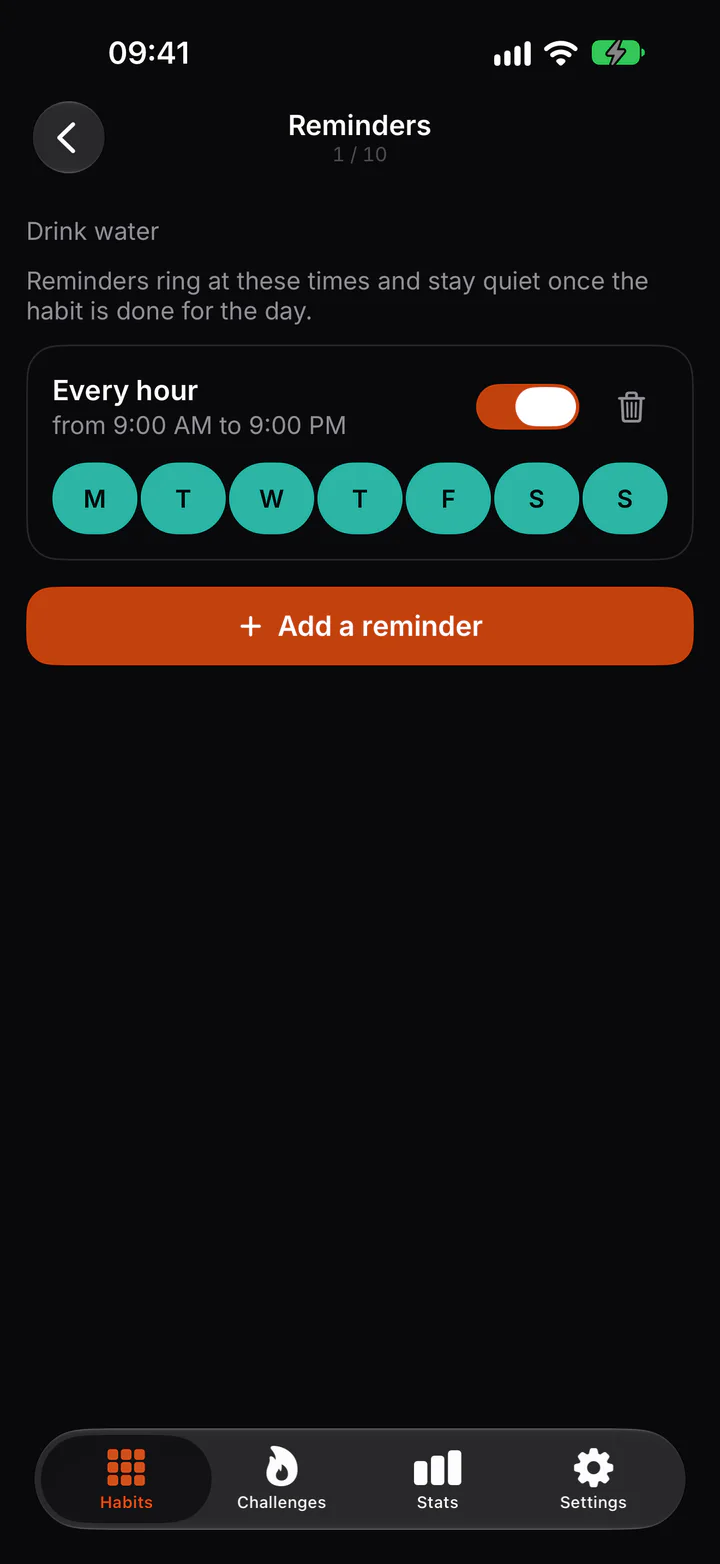
Two details make this reminder bearable. It stays quiet once the habit is done for the day: if you’ve had your eight glasses by 4 p.m., you won’t hear anything else until tomorrow. And the notification carries two actions, “Done” and “Later.” The first logs a glass without opening the app, and the second puts the reminder off when you don’t have water at hand. With a paired Apple Watch, the same actions show up on your wrist.
Set the window to your useful waking hours. Ending at 9 p.m. rather than 11 p.m. keeps you from downing two big glasses right before bed. And if one notification an hour feels like too much, switch to a wider interval instead of turning the reminder off altogether.
Finally, think about the days. A reminder can be set for the days you choose: if your weekends look nothing like your week, you can keep the hourly reminder Monday through Friday and skip it on Saturday and Sunday.
Count without thinking
For water, “Yes / No” tracking doesn’t say much: it records that you drank, not how much. “Counter” tracking fits better. You set a daily goal, eight for example, and each tap on the habit’s button adds one. Today’s tile fills up as you go, and it’s only full once you hit the goal.
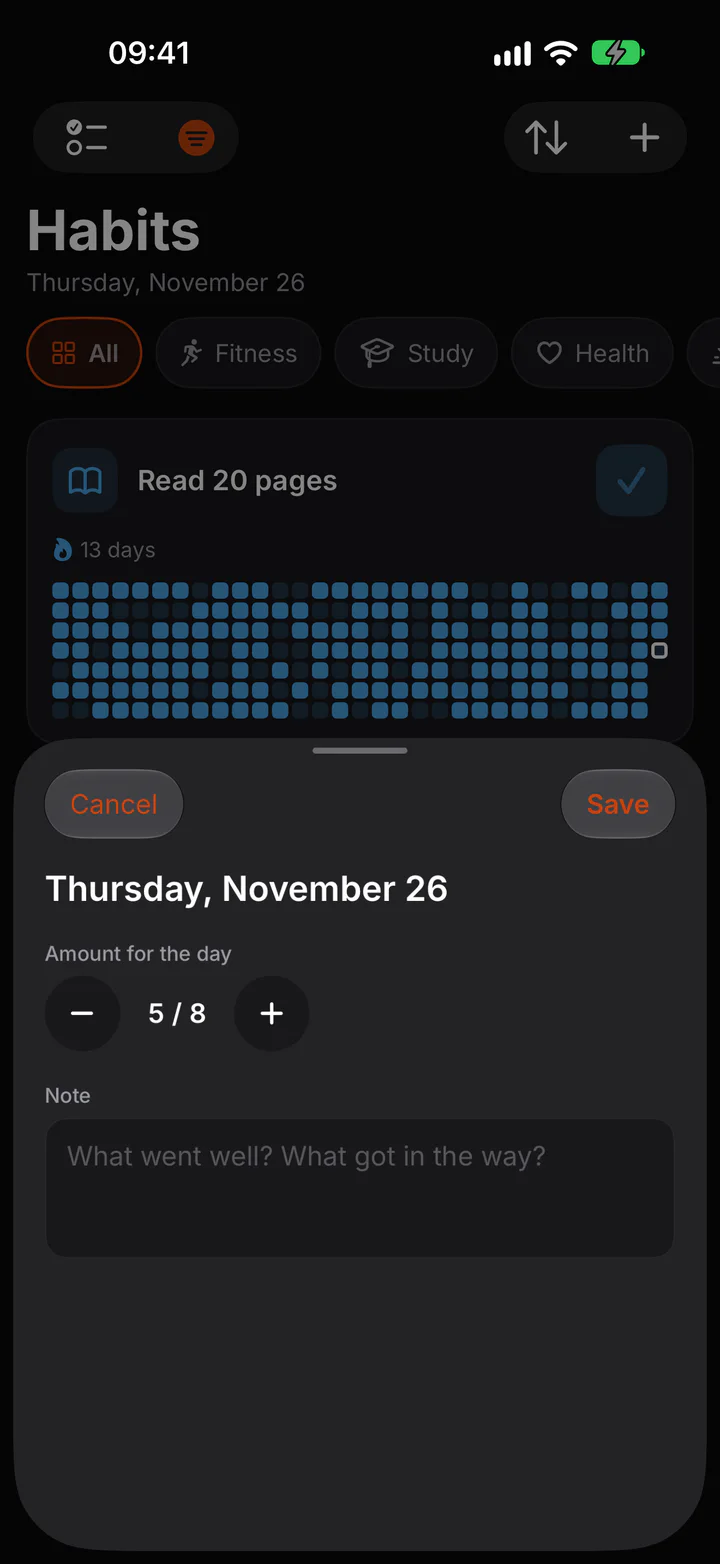
A long press on the button opens the day sheet. Use it to catch up on something you forgot (three glasses at lunch you didn’t log) or to fix a mistake, with the − and + buttons. You can also leave a note there, such as “hiking day,” to make sense of an unusual number later.
If your phone usually stays in your pocket, the medium widget shows the habit with a button to check it from your Home Screen. The article on habit widgets explains how to add it.
What the grid shows after a month
After a few weeks, open the habit’s detail screen. Full days and half-filled days quickly form a pattern. For many people, weekends are paler than weekdays, because the bottle stays at the office and the cues change. For others, it’s travel days. Once the grid shows you when you tend to forget, you can fix that one point: a second bottle at home, a reminder moved on Saturdays.
You may also find that the goal was poorly chosen. If you reach six almost every day and never eight, lower the goal to six for a month. Past days keep their old goal and the new one only counts from today, so your grid doesn’t change retroactively. You can raise it again later if you feel like it.
The hourly reminder is mostly useful at the start. Once the bottle and the fixed moments are enough, space it out, then turn it off and keep only the counter. If you’re also trying to drink less coffee, water makes a good replacement for the afternoon cup: the article on cutting back on coffee starts from there.
Frequently asked questions
How many glasses of water should I drink a day?
The UK’s National Health Service (NHS) gives 6 to 8 cups or glasses of fluid a day as a guide for most people, counting tea, coffee and milk too. You need more in hot weather, during long physical activity, and when pregnant or breastfeeding. For a specific medical situation, ask your doctor.
Do tea and coffee count?
According to the NHS, yes: water, lower-fat milk and lower-sugar drinks, tea and coffee included, all count toward your fluids for the day. What your counter tracks is up to you. Some people count only water to keep the rule simple.
Isn’t a reminder every hour too much?
It can be if you’re often in meetings. In HabitLove, the repeating reminder is adjustable: you choose the interval and the start and end times. It stops going off as soon as you reach your goal for the day.
How do I count my glasses in HabitLove?
Create a habit with “Counter” tracking and your goal in glasses. Each tap on the habit’s button adds a glass. A long press opens the day sheet so you can correct the number.
Sources
Track this habit in HabitLove
One grid per habit, with reminders and streaks. Free, no account needed.