How to Meditate Every Day: Start Small and Keep Going

The short answer
Start with two to five minutes, in the same spot and after the same action every day, for example after your morning coffee. A session where your mind keeps wandering still counts: you sat down, and sitting down is the habit you are building. Check off each day and jot down a line about a session now and then, to see what makes it easier to start.
Why this habit slips away so easily
Meditation has a weakness most other habits don’t share: it leaves no trace. After a run, you’re tired and you have the miles logged. After twenty pages, your bookmark has moved. After ten minutes of following your breath, nothing around you has changed, and some days you get up thinking the session was a failure.
On top of that, it’s never urgent. Nobody is waiting on you, and no deadline passes if you push it to tomorrow. Habits like that are the first to disappear when the week fills up.
To make it stick despite those two weaknesses, you need a session short enough that it never competes with anything else, a clear trigger, and a visible record that you make yourself.
Start with two minutes
Twenty minutes a day is a fine goal for someone who has meditated for a year. As a starting point, it’s too much: on the day you don’t have twenty minutes, you do nothing at all. Two minutes, on the other hand, you can find even on moving day.
Two minutes may sound silly, and that’s a good sign, because you won’t find a reason to skip them. In the first weeks, what you’re really building is the act of sitting down every day, and the length hardly matters. The article on how to build a habit that lasts comes back to this idea of the smallest possible step.
Later, you can go longer in steps. When two minutes have felt effortless for two or three weeks, move to five, then to ten if you feel like it. Nothing forces you to keep climbing. You can stay at five minutes for years if that’s what fits your life.
A time, a place, a cue
Decide three things and leave them alone for a month.
The time. Tie the session to something you already do: after your coffee, after your shower, when you get home from work before you take your shoes off. “After coffee” works better than “at 7:15” because the clock shifts on weekends while the coffee stays. If you put the session in the morning, it can slot into a morning routine you already have.
The place. Always the same one: a particular chair, a cushion in a corner, the edge of your bed. You don’t need any gear, only a spot where you can sit with your back straight without being interrupted for a few minutes.
The length. Set a timer with a gentle sound so you don’t open your eyes every thirty seconds to check. If you use your phone, put it in airplane mode for the session.
For the practice itself, the simplest approach is enough at first. Rest your attention on your breathing, wherever you feel it most clearly, in your belly or at your nostrils. When you notice you’re thinking about something else, come back to the breath without commenting on it. A guided session works too if a voice helps you stay put. Pick one of the two and stick with it for a few weeks, because switching methods every three days means starting over every time.
What counts as a session
Settle this now, because it’s where tracking most often goes wrong. Many beginners only check off the “good” sessions, the ones where they felt calm. On the other days they decide they didn’t really meditate, and the grid empties out even though they sat down every morning.
Use a simpler rule: you sat down, the timer went off, the day is done. Whether your mind stayed on your breath or spent two minutes drafting an imaginary email makes no difference to the check mark. Bringing your attention back each time it wanders is part of the exercise, and some days you’ll bring it back fifty times.
A “Yes / No” habit fits this rule. It records that you sat down and never asks you to rate the session.
Track it and write one line
In HabitLove, a “Meditate” habit set to “Yes / No” is all you need. You check it off from the Habits tab, in the Cards view if you like seeing each habit’s grid, or from a widget on your Home Screen.
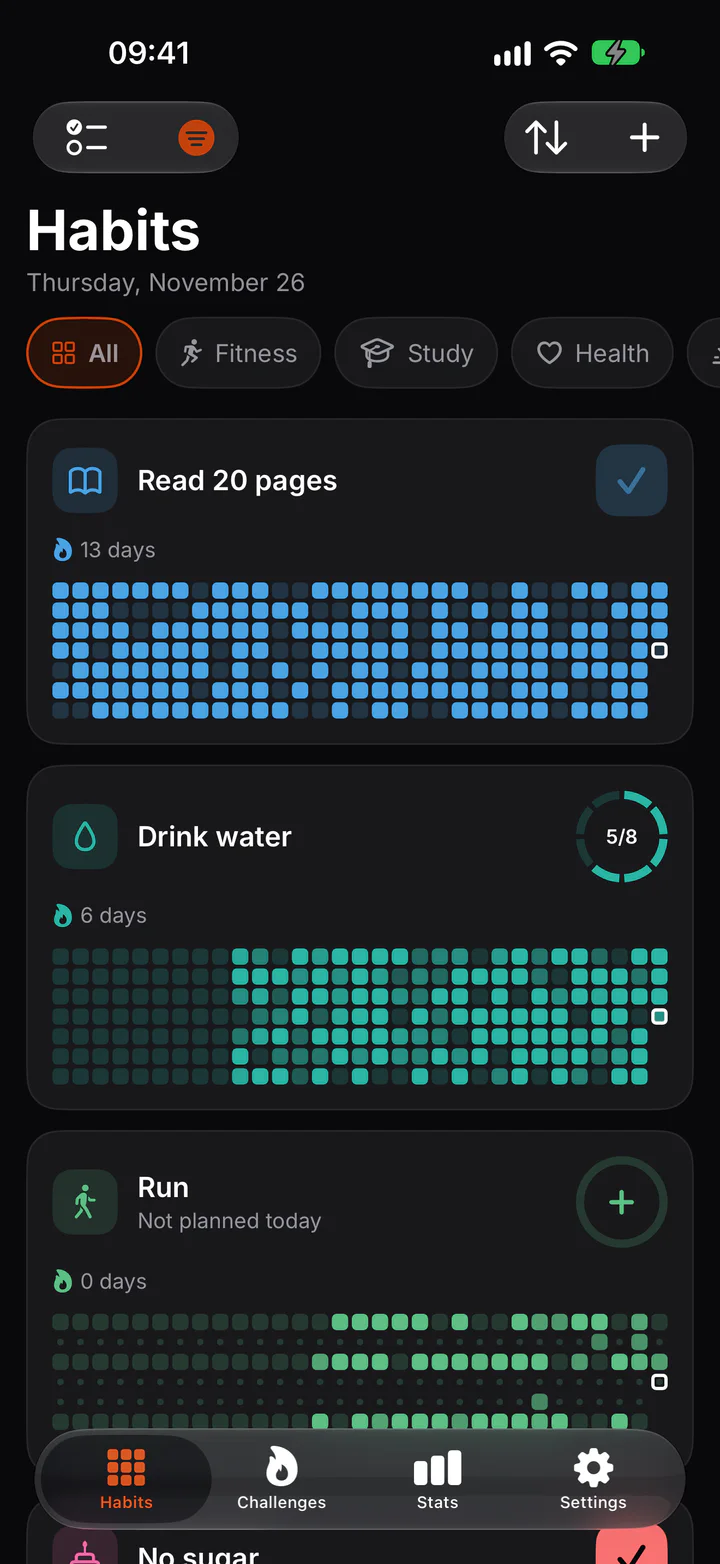
The grid provides the trace that meditation lacks. Every session leaves a tile, and after a month you see thirty days at a glance, which your memory would never give you. On days when you wonder whether any of this helps, it at least shows you that you kept going.
To keep a sense of what happened during a session, write a line in “Today’s note,” right after or in the evening. The screenshot below shows a few: “Great session this morning,” “Hard to get started,” “Short but effective,” “With friends.” None of them is longer than four words.
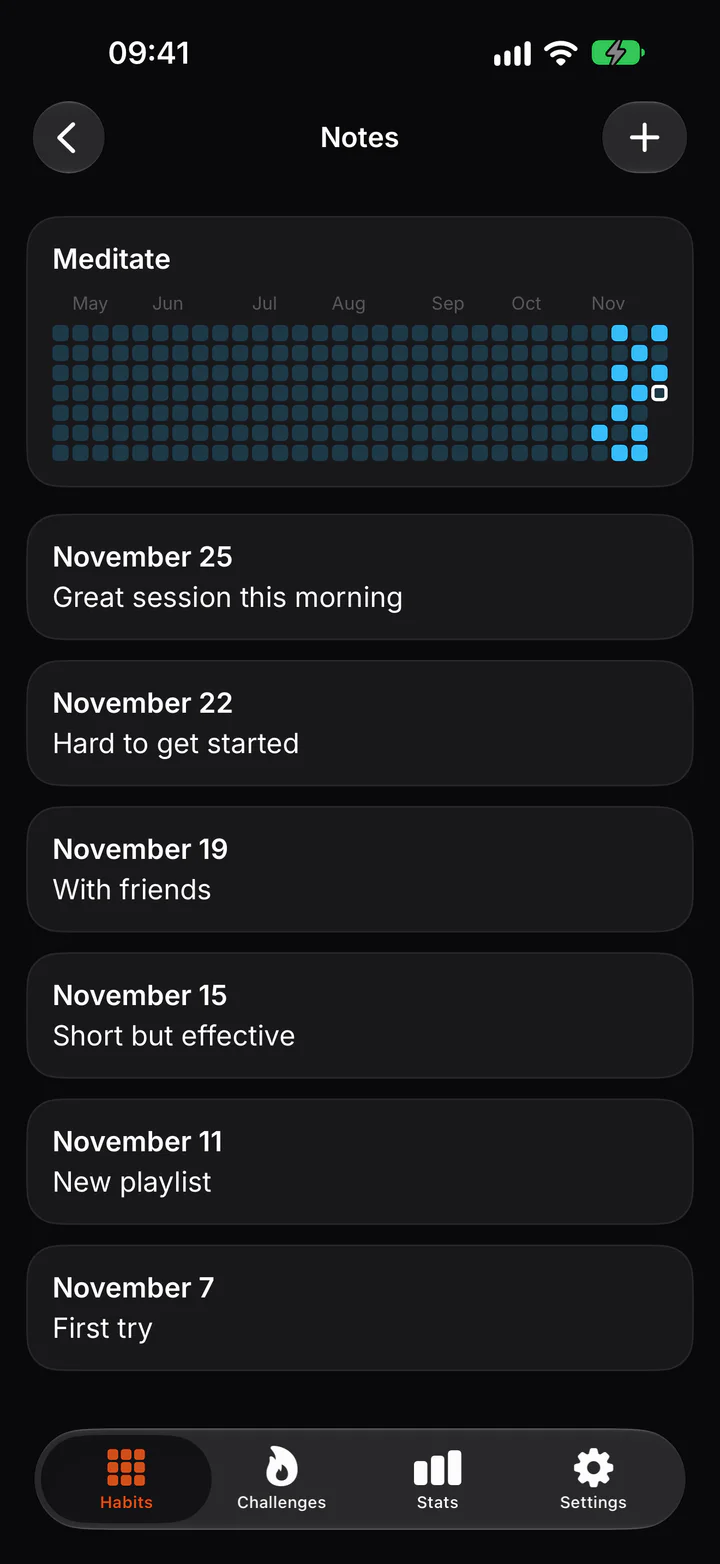
Don’t write every day, or you’ll get tired of it. Add a note when something is out of the ordinary: a session somewhere else, a new time slot you tried, a day you almost skipped and what made you sit down anyway. Read a month later, these lines show you when sitting down comes easily and when you drag your feet. You can go over them during your weekly review, along with your other habits.
For the first few weeks, a reminder can act as your trigger, set just after the time you usually finish your coffee or get home. It stays quiet on days you have already checked off.
Missed days and getting back on track
You will skip days, because of a cold, a trip, or a week where everything piles up. If you miss one session, nothing is lost: do the next one at the usual time, without trying to catch up with a double session.
If you’ve stopped for two weeks, start again at the first step, two minutes, even if you were doing ten before. You’ll work your way back up quickly. When you restart, sitting down that first time takes the most effort, and a short session makes it easier. Your grid keeps the weeks before the break, and a streak that resets to zero doesn’t erase them. The article on streaks and slips explains how to look at those numbers without getting discouraged.
If you’re going on vacation, or into a stretch where you know you won’t meditate, you can archive the habit from its menu. It leaves your list, its grid is kept, and when you’re back you bring it back from “Archived habits” in the app’s Settings.
Meditation can also bring up difficult thoughts or emotions. If sessions regularly leave you feeling worse than before, or if you’re going through a period of anxiety or depression, talk to a doctor or a psychologist before you keep going on your own.
Frequently asked questions
How long should I meditate when I’m starting out?
Two to five minutes is enough to build the habit. A short session fits into any day and takes away the “no time” excuse. You can go longer once sitting down has become automatic, a few minutes at a time.
Is it better to meditate in the morning or at night?
The best time is the one you can keep every day. Mornings have the advantage of coming before anything unexpected. Evenings work if your mornings are too packed, but tiredness makes the session easier to skip. Try one time slot for two weeks before you judge it.
I can’t stop thinking. Does the session still count?
Yes. Noticing that your attention has drifted and bringing it back is the exercise itself. For tracking, the rule is simple: if you sat for the time you planned, the day is done.
Do I need a guided meditation app?
No. A timer is enough for a silent session. If a voice helps you stay seated, keep it. HabitLove does not guide sessions: it tracks the days you meditated and keeps your notes.

Track this habit in HabitLove
One grid per habit, with reminders and streaks. Free, no account needed.